Haunts of History: How Halloween – and mischief – came to Vermont

Originally published in the Times Argus/Rutland Herald Weekend Magazine, October 29, 2022 for the “Remember When” column with the title, Up to No Good

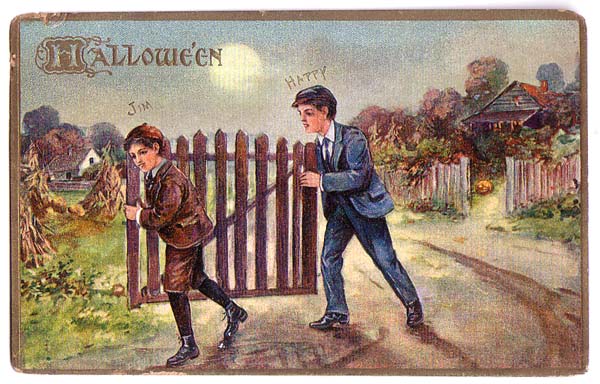
Cabbage Night was also known as Gate Night

“There is in every village and hamlet in America, a vulgar class of recreant mortals, who endeavor yearly to signalize the anniversary of ‘Halloween,’ by acts and deeds, more characteristic of devils than of boys or men.”

This moral outcry, published in the November 2, 1872 edition of the Middlebury Register, was in response to a “disgraceful scene” that had occurred that Halloween night. On Seminary Street in Middlebury, “the witches” had taken “gates off their hinges, and exchanged them for a neighbor’s gate… other gates were borne away to secret places.” Among “other annoyances too numerous to mention,” “door bells were rung.” Two cast iron lions were also taken from their perches atop a stone entryway and thrown in the mud. 

Why were the boys up to such mischief, and why on October 31st specifically? To answer that question we have to take a whirl-wind journey through 3,000 years, give or take a few, beginning with the ancient Celts. 

Continue reading

Apples, apples everywhere: When homegrown became Vermont’s business

Originally published in the Times Argus/Rutland Herald Weekend Magazine, October 1, 2021 for the “Remember When” column with the title, Apple of Vermont’s Eye

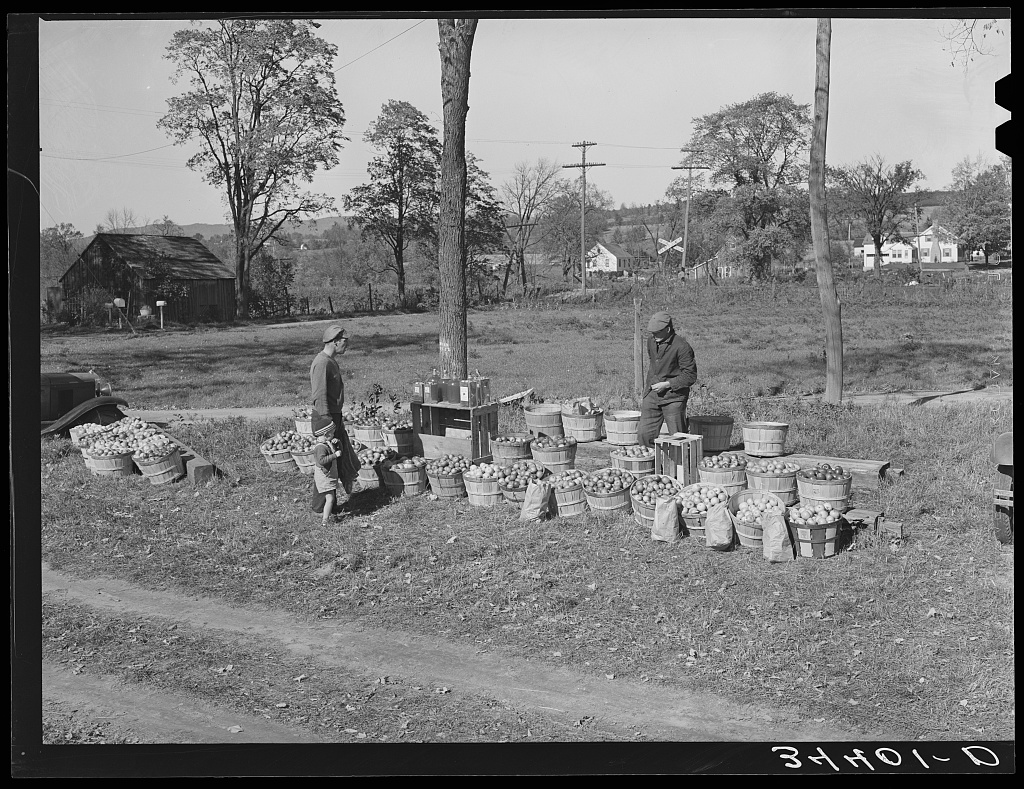
This roadside fruit stand was pictured near Bennington in 1939 (Library of Congress)

In September 1922, Bess M. Rowe penned an article for The Farmer’s Wife after she visited the Dimock Orchard Farm in East Corinth. In “Bringing Back the Old Trees,” Miss Rowe wrote of the charming conversations she had with the self-named “farmerettes” who, since taking charge while “the men” were away at war, continued to be instrumental to the farm’s successful operation. After Mr. and Mrs. Julian Dimock — a magazine writer and former professor, respectively, and farming novices both — moved to Vermont and started the farm 10 years earlier, they were proving themselves adept orchardists.

Their success could be put down to natural talent or, as Miss Rowe noted, their receptiveness to “modern ideas and methods,” and having “nothing to unlearn.” But the couple’s move into apple-growing also came at an opportune time in Vermont’s fledgling apple industry.

Continue reading

Early Female Education: Because Women were Cheaper

Originally published in the Times Argus/Rutland Herald Weekend Magazine, June 18, 2022 for the “Remember When” column with the title, “Female education: From the home to the school house

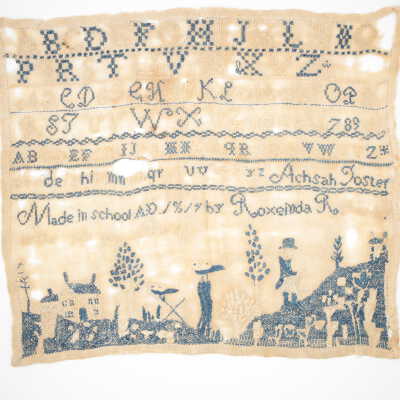
Sampler made in Orange, Vermont, with text: “Made in school A.D. 1814 by Roxcinda Richardson”
(Vermont Historical Society)

1800–20

Early Vermont women were far from uneducated. In the 1770s, literacy among females is estimated to have been at 60%, and by 1820, over 80%. But most girls educated prior to 1800 could only expect to learn enough basic skills to become a proficient housekeeper.

When Miss Ida Strong opened a girls-only school in Middlebury in 1800, it was the first of its kind in Vermont. The idea of designing schools and curricula specifically for girls was progressive and marked the beginning of a nascent trend in Vermont’s female education.

Continue reading

Educating women to be interesting wives

Originally published in the Times Argus/Rutland Herald Weekend Magazine, May 18, 2022 for the “Remember When” column with the title, “Female education, for happiness and cordiality

Sampler made in Orange, Vermont, with text: “Made in school A.D. 1814 by Roxcinda Richardson” in the 9th year of her age.
(Vermont Historical Society)

“Whatever the fine ladies think of the matter, it is certain that the only rational ambition they can have must be to make obedient daughters, loving wives, prudent mothers and mistresses of families, faithful friends, and good Christians.” 

From the “Of the peculiar Management of Daughters” in the August 14, 1802 edition of Randolph’s Weekly Wanderer

At a time when schooling was usually limited to subjects and skills deemed absolutely necessary to their future roles as wives and mothers, the above statement makes sense. But it was actually in an 1802 article written in support of furthering the formal education of young girls. 

Two years earlier, Miss Ida Strong – considered to be the “pioneer of female education in this state “ by Vermont’s more famous first lady of education, Emma Willard – had begun instructing the “various branches of Female Education” at the Middlebury Female Seminary. And in her belief that girls should receive a more well-rounded and thorough education than had their mothers and grandmothers, she was not alone. 

Continue reading

When Vermont almost gave Frost the cold shoulder

Originally published in the Times Argus/Rutland Herald Weekend Magazine, April 23, 2022 for the “Remember When” column with the title, “When Frost almost got heaved.”

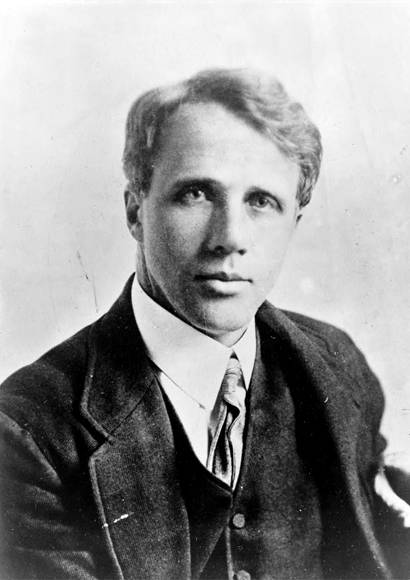
B/W photo of young Robert Frost from 1910s
Robert Frost in the 1910s (Wikicommons)

One hundred years ago, long before April would be designated as National Poetry Month or March as Women’s History Month, the following little known story offers an interesting intersection of the two. In addition, our still sometimes not-so subtle resistance to “outlanders” has been brought into sharp focus over the last few years and so it is always timely to look to history to see just how far—or not—we have come. 

On April 17, 1922, Miss Fanny B. Fletcher of Proctorsville gave a lecture and poetry reading at Ludlow’s Fletcher Memorial Library. Miss Fletcher, who “spoke with the authority of one who had studied our Green Mountain poets well,” had been appointed by the Vermont Federation of Women’s Clubs to compile a list of potential state poet laureates. The “impelling motive” was that of “creating interest in Vermont verse.” 

Miss Fletcher’s talk, titled “Poets of Vermont” and “interspersed with humorous anecdotes,” was a follow-up to the Free Public Library Commission’s publication of Miss Fletcher’s candidate roster. Newspaper articles about the upcoming election encouraged Women’s Clubs around the state to study the poets’ work and then vote for their favorite.

This action would start a debate neither Miss Fletcher nor Mrs. O. H. Coolidge, president of the Rutland Woman’s Club and originator of the idea, could have anticipated. 

Continue reading

Radio Comes to Vermont

Originally published in the Times Argus/Rutland Herald Weekend Magazine, March 19, 2022 for the “Remember When” column with the title, “Can You Hear Me Now?”

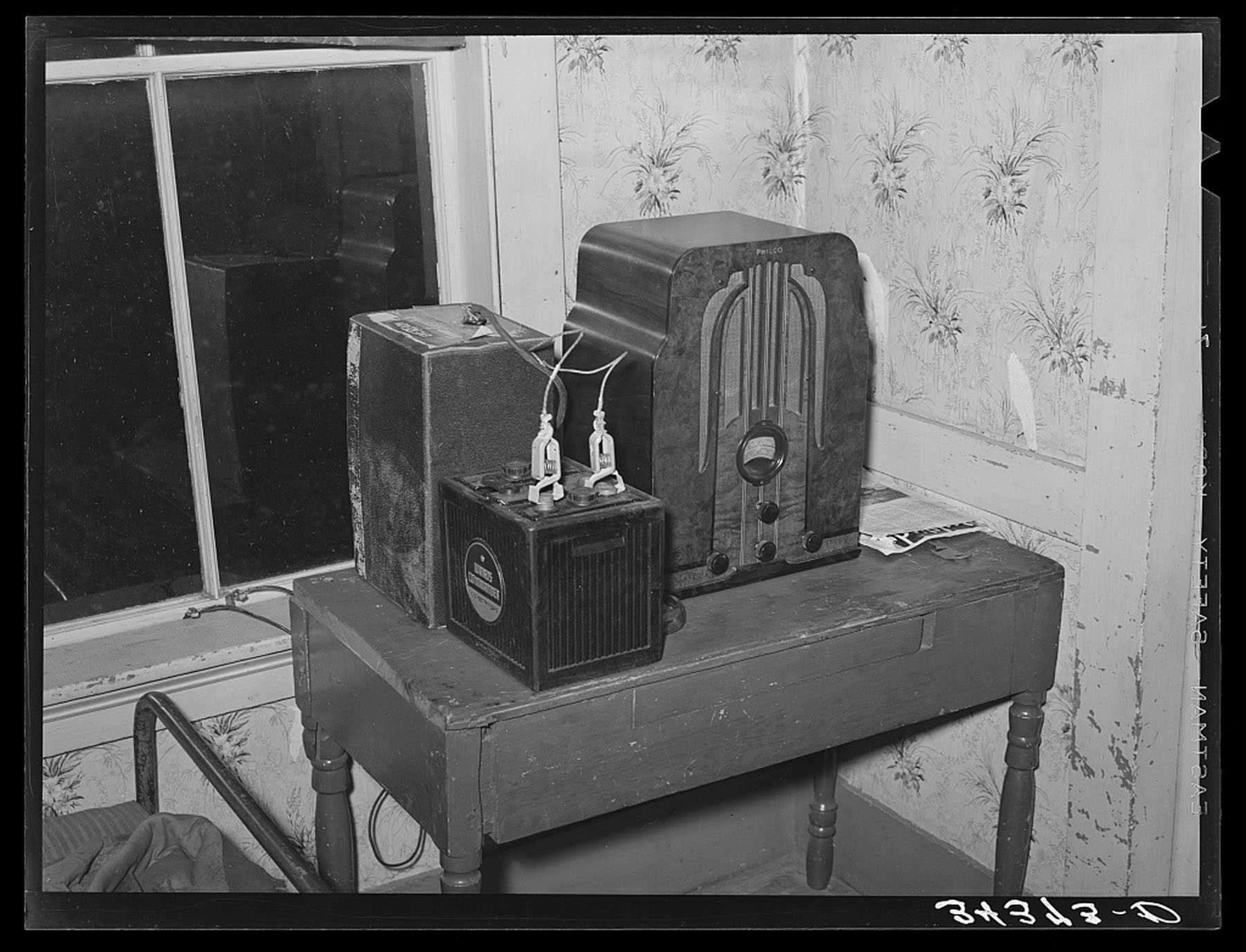
Radio in a home in Bradford, Vermont, 1939 (Library of Congress)

In April 1930, the U.S. Census enumerators knocking on Vermonters’ doors asked a question unlike any asked before (or since): “Do you own a radio?”

The census ultimately found that, in 1930, 40-50% of Vermont households did, indeed, own a radio. This ranked the state among the highest radio-owning states, lagging behind only a handful of other northern states (plus California), which boasted up to 63% ownership.

(Many southern states, on the other hand, trailed far behind with only 5-10% of their population owning a “wireless.”)

The first successful public American radio broadcast aired from the Metropolitan Opera House in New York City in 1910, but restrictions placed on radios during World War I temporarily thwarted this new form of communication. But when the war ended, soldiers who had served as radio operators returned stateside, bringing with them their new technological skills.

Continue reading

Messiah in the Mountains: When Vermonters First Sang Hallelujah

Originally published in the Times Argus/Rutland Herald Weekend Magazine, December 18, 2021 for the “Remember When” column with the title, “Hallelujah!: When the Messiah came to Vermont.”

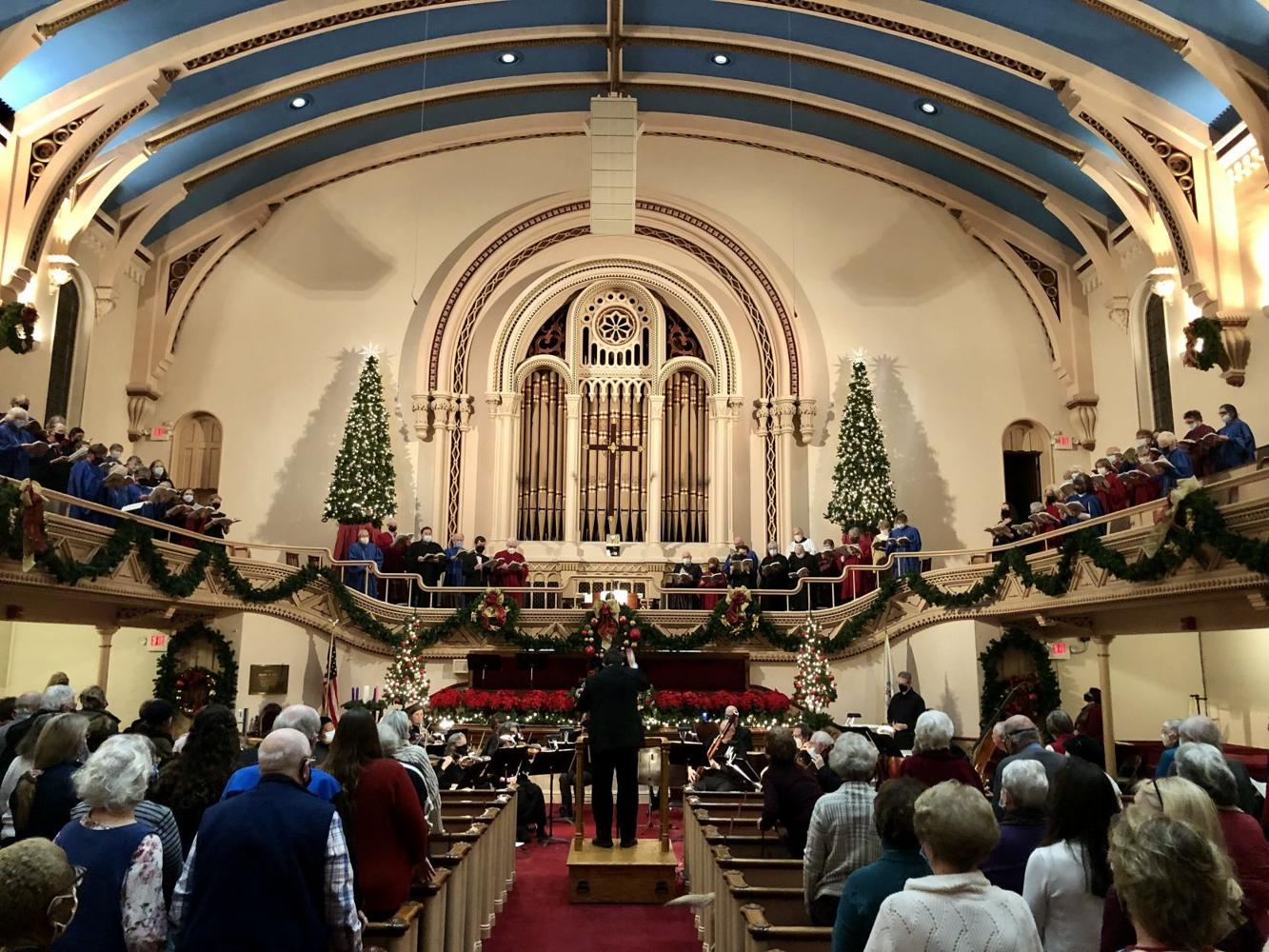
A capacity crowd stands for the “Hallelujah” Chorus at the finale of Handel’s “Messiah,” an annual holiday concert at Rutland’s Grace Congregational Church, conducted by Alastair Stout.
Photo by Arthur Zorn

On May 7, 1822, Thomas P. Matthews, “Sec’y” of the Addison County Musical Society placed an ad for their “Annual Concert at the Meeting House in Middlebury.” Extending a “general invitation” to “all Choirs in the County,” he also specifically and “respectfully invite(d) the assistance of Ladies acquainted with the music.”

What music would that be? Well, not what you might expect in the valleys and hillsides of a sparsely populated, farm-dotted state 3,000 miles away from Europe: Handel’s “Messiah,” the “Grand Hallelujah Chorus” and excerpts of Part III, to be exact.

Three centuries later, for the descendants of those Middlebury singers, as it is for many Americans, “Messiah” has become as synonymous with Christmas as Santa Claus and eggnog.

Continue reading

Why Don’t You Go Ice Skating at Castle Park? Barre gets an ice rink

Originally published in the Times Argus/Rutland Herald Weekend Magazine January 2022 in the “Remember When” column with the title “Castle Park, Barre’s short-lived skating rink”

In December 1909, a Montreal-born stone mason-cum-successful Barre contractor and real-estate investor named Edmund Napoleon Normandeau slid in to save the town’s children from the perils of ice skating.

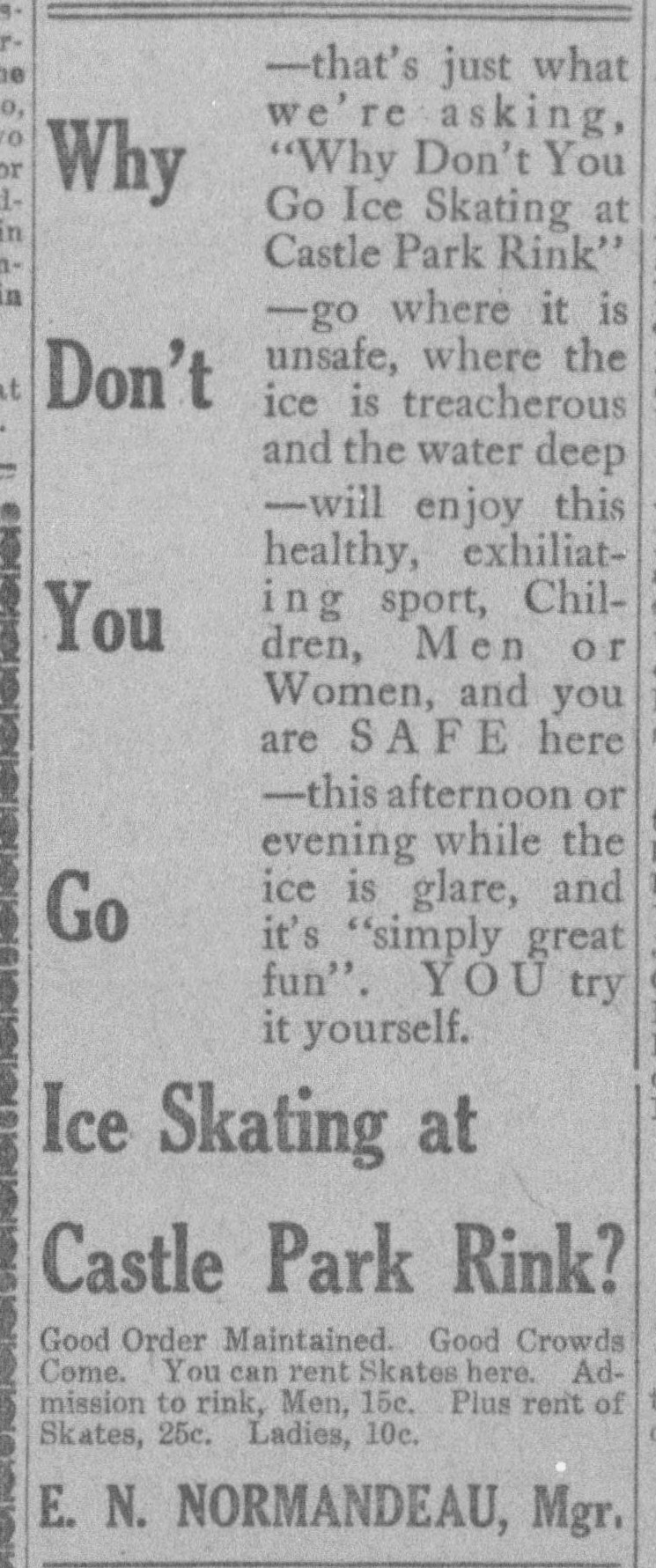
“Don’t go where it is unsafe, where the ice is treacherous and the water deep,” a February 1910 ad pleaded. “Why Don’t You Go Ice Skating at Castle Park Rink? You are SAFE here.”

This wasn’t just hyperbole.

Continue reading

For sale to the highest bidder: When Vermont church pews were considered personal real estate

Originally published in the Times Argus/Rutland Herald Weekend Magazine on 2.19.22 in the Remember When column with the title “Church Pews for Sale or Rent”

Old First Church, Bennington, Vermont. Photo credit: Joanna Tebbs Young

On Nov. 25, 1835, Mr. Seth Shaler Arnold wrote in his diary: “Attended the sale of the pews in new Meeting house Westminster. Bid off one for Esther — two for father and one for myself and Mr. Ruggles.”

Two years later in June, he wrote: “Settled with Mr. Ruggles. Bought his share of ⅓ of pew No. 8.” And by August, Mr. Arnold was musing on the fact that “Mrs. Cobb commenced sitting in my father’s pew and then changed to mine — Mrs. Nutting has sit (sic) there more than a year. And Mr. Hollis Wright’s family have just commenced sitting there. The two former at 75 ct. each and the latter at about 2 dollars.”

Buying church pews? Renting them out? What was going on here? What might appear socially discriminatory (or morally questionable) to the modern eye, was an economic necessity at a time when communities were establishing themselves in a young New England.

Continue reading

Happy 100th to Windsor, Vermont’s Namco Block Apartments

Originally published in the Times Argus/Rutland Herald Weekend Magazine in December 2021 in the “Remember When” column with the title “One Hundred Thanksgivings.”

In November 1921, the Johnson family, formerly of Springfield, Vermont, enjoyed  Thanksgiving in their new, cozy, light-filled rooms overlooking Mill Brook in Windsor. They had moved to the not-quite-finished Namco apartments earlier that year of 1921, and in doing so marked their name down in history — or at least in the April 29th edition of the Vermont Journal — as the very first tenants of the then largest residential building in New England. 

The Namco block (now Union Square), the majestic red-brick apartment building at the corner of Windsor’s Union and Main Streets, was built in 1920 by the L.A. LaFrance Company of Holyoke, Massachusetts. Originally designed as family housing for the employees of the National Acme Company (Namco), it is an architectural surprise, seemingly out-of-place in a small Vermont village. With its rows of bow windows “undulating… along… [its] extremely long facade,” as a National Register of Historic Places report describes it, is as much an impressive sight now as it surely was a century ago. 

Continue reading