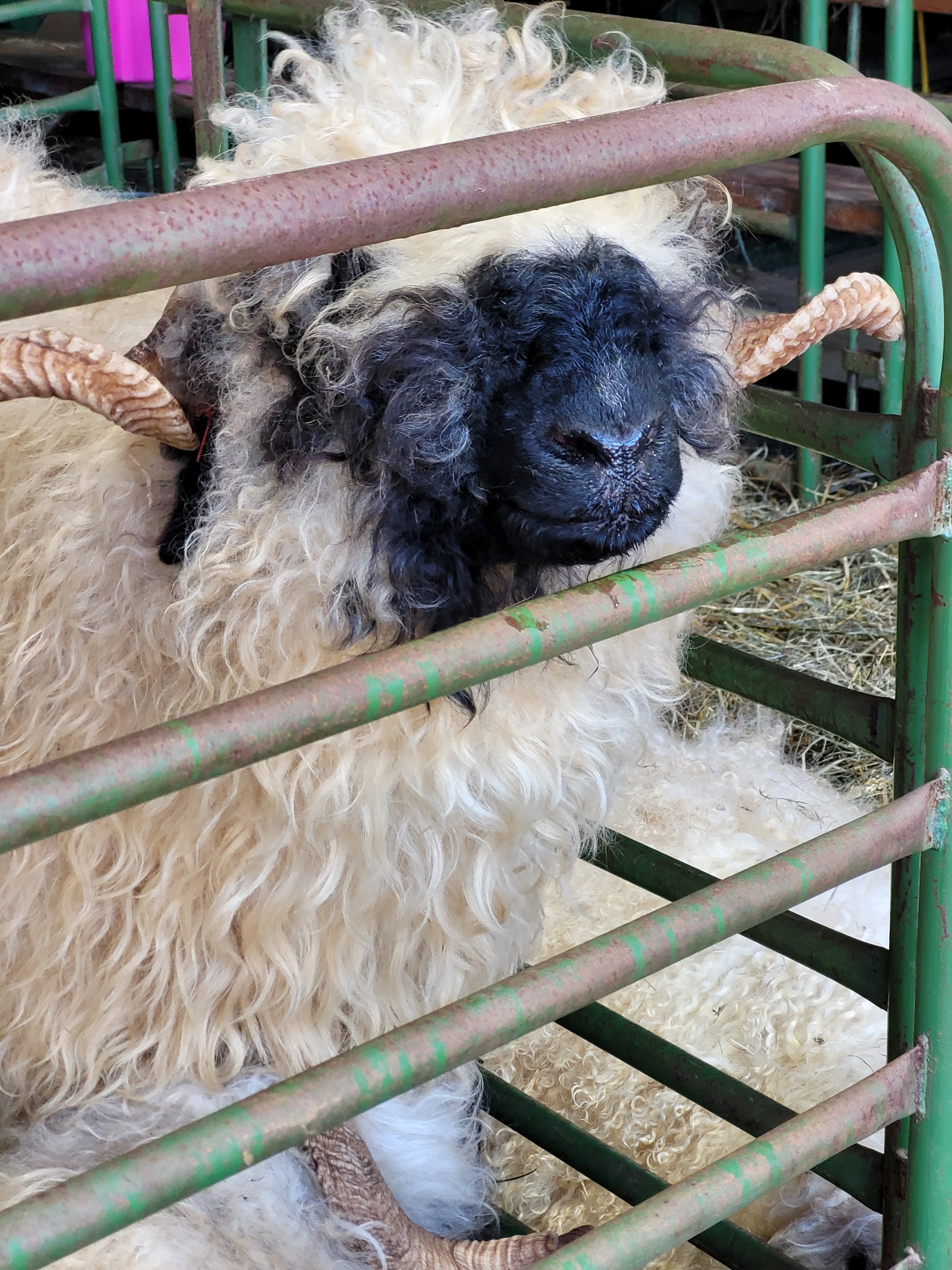
A possible descendent of one of Vermont’s early sheep herds at Tunbridge Sheep & Wool Festival. Photo by Joanna Tebbs Young
(Originally published in the Rutland Herald/Times Argus “Weekend Magazine,” April 20, 2024)
Vermont’s short-lived wool industry was as rocky as the fields on which the sheep grazed and as up-and-down as its mountains.
Between roughly 1775 and 1825, European settlers — the majority of whom were of English origin from other parts of New England — were moving north into Vermont. Primarily subsistence farmers, they cleared small patches of hillside on which to grow their own food and graze English breeds of sheep which were raised for meat, not wool.
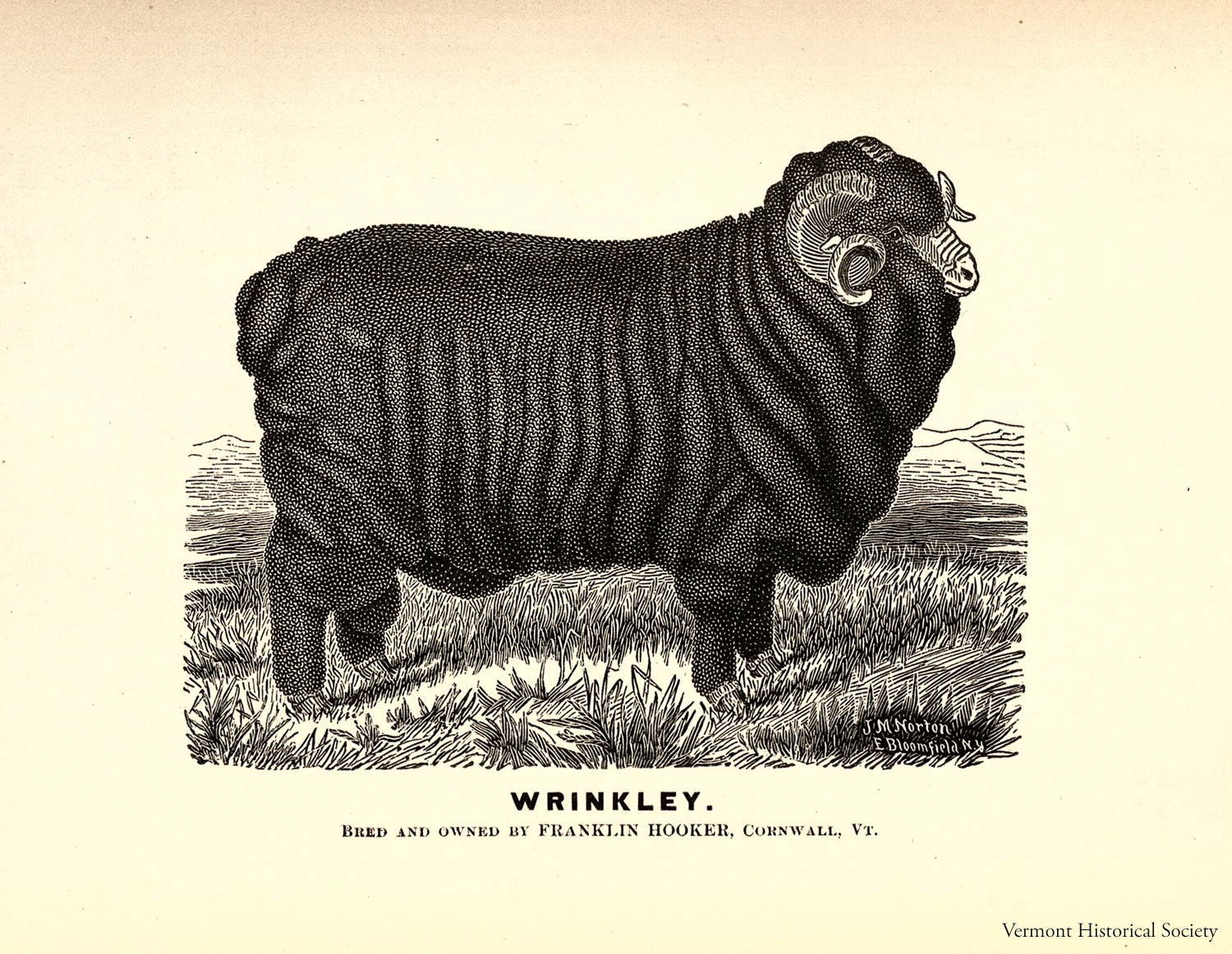
In 1809, the American Consul to Portugal, William Jarvis, imported 200 Merino rams from Spain. Merino wool was of higher quality than that of the English breeds — softer and more versatile. Its uniquely kinked fibers trapped more air and absorbed more water away from the skin, keeping the wearer warmer in the winter and cooler in the warmer months.
Moving to a farm in Weathersfield, Vermont, Jarvis eventually shipped 4,000 sheep to the U.S. He went on to breed and sell these to Vermonters, who, in turn, expanded their farming operations and began selling their wool to local mills.
Photo courtesy of Vermont Historical Society
During the War of 1812, demand for such wool rose as factories were commissioned to make uniforms, but then fluctuated over the following decade. By 1820, however, in part due to protective tariffs, mills were paying farmers well for their wool. Soon sheep farming was more profitable than dairy or crop farming. Farmers were replacing their cows with sheep at such a frenetic rate that between 1824 and 1840 the sheep population had quadrupled. According to records from the time, in 1837, Vermont was home to more than one-and-a-half million sheep, six sheep per resident. Every town in the state was grazing at least 1,000 sheep and some had over 10,000.
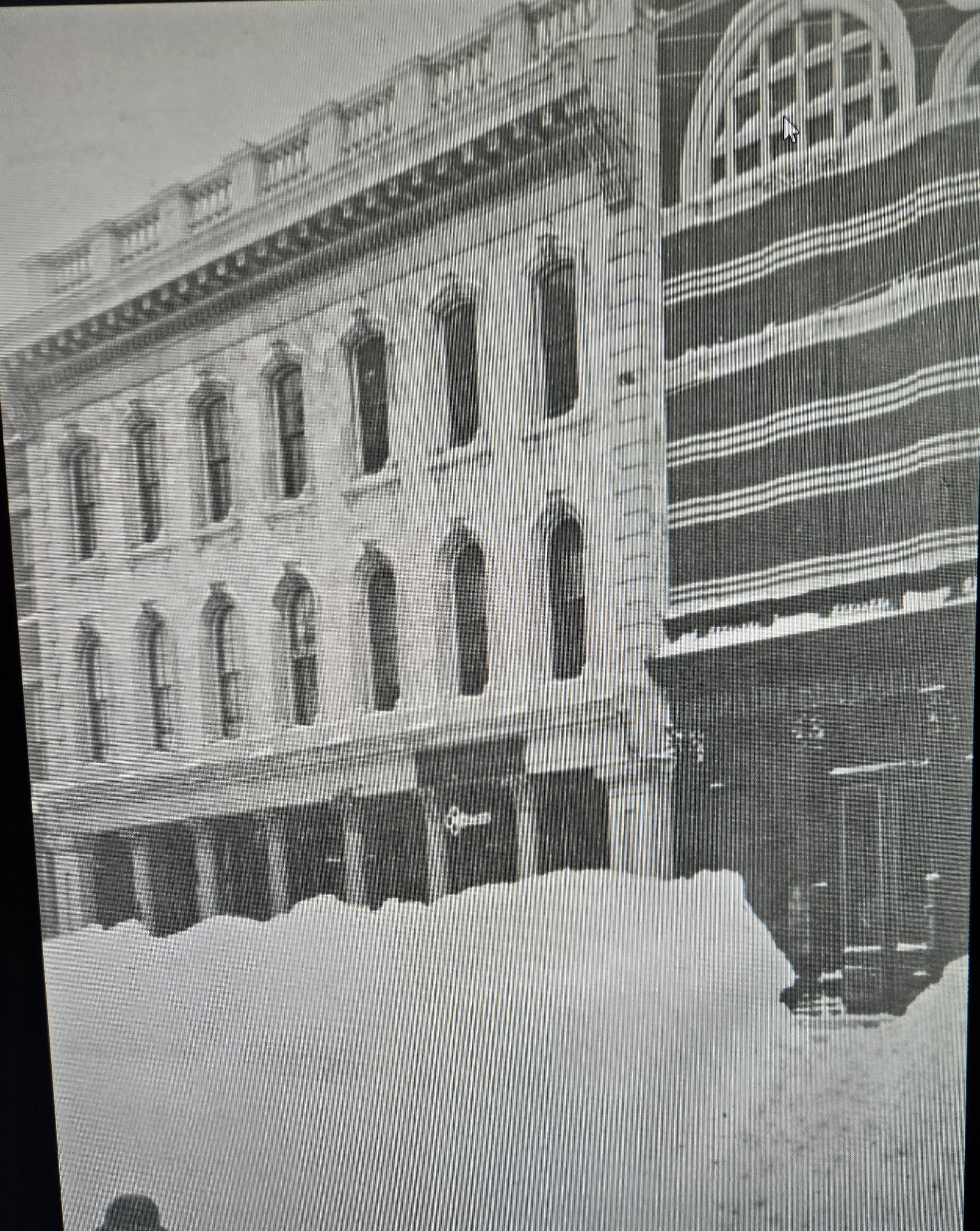
Center Street, Rutland, Vermont. March 1888 (Rutland Historical Society)
(Originally published in the Rutland Herald/Times Argus “Weekend Magazine,” March 23, 2024)
In the late 19th century a rivalry arose between the Midwest and East of the United States — over the weather. Newspapers in the Dakotas in particular liked to make fun of New England’s supposedly awful winters, which, compared to theirs… well, didn’t. Snarky quips, such as these from Redfield (South Dakota) Journal, were sometimes printed in the papers: “Liartown, N.Y…. citizens have made tunnels along the sidewalks and at the crossings by eating the snow as they proceeded.” And: “A woman at Pittsfield, Vt. went out… the blizzard overtook her. She was blown to atoms.”
The West’s one upmanship was mostly justified. Especially in 1888, when a massive and unexpected January storm — which became known as the Children’s Blizzard — killed hundreds of people, many of them school children and teachers, who, on a day that had started springlike, found themselves walking home in sudden frigid temperatures in a raging blizzard.
But two months later, on March 12, 1888, the East saw the start of a storm that not only rivaled the Midwest’s, but one of the biggest snowstorms in US history and by far the worst Vermont had/has ever recorded. The storm even prompted the Minnesota Journal to declare that “the Dakotan may thank his lucky stars that he does not live in the storm-ridden East.”
This is a repost of an article originally published in the Rutland Herald/Times ArgusWeekend Magazine on January 20, 2024.
For our ancestors, winter in rural Vermont was long and arduous. The short days were crammed full with laborious farm and house chores while the dark nights were long and filled with… not much. Maybe dreams of warmer days? And when the snow was too deep for even ox-pulled snow rollers to clear a path, it was not unheard of for some families to be housebound for days at a time.
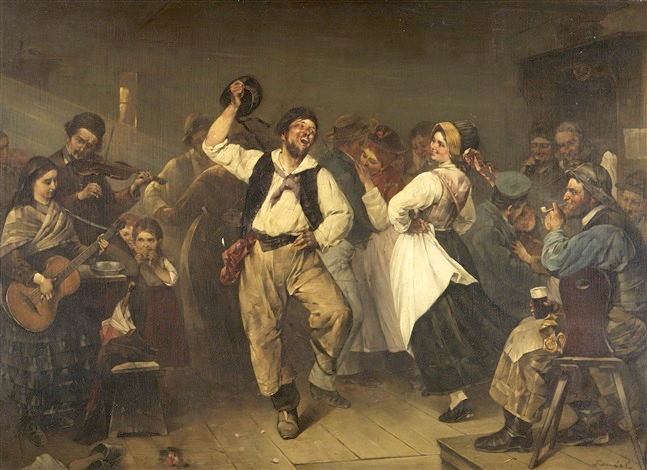
But Vermonters — many of whom were not long descended from the dance and music-loving English, Scottish, and Irish, or were newly settled French-Canadians — knew how to brighten the dark nights: With music. And more specifically, with a “kitchen junket” or “tunk.”
This is a repost of an article originally published in the Rutland Herald/Times ArgusWeekend Magazine on September 23, 2023.
credit: Brattleboro Historical Society
Pus-filled boils, anyone? Brattleboro’s Wesselhoeft Hydropathic Institution was once a favorite of New England’s literary elite despite its questionable treatments.
Horace Greeley, Julia Ward Howe, Harriet Beecher Stowe, Catharine Beecher, and Henry Wadsworth Longfellow… undoubtedly some of the most famous progressive and creative thinkers of the 19th century. As well as all knowing each other, they have something else in common: they spent time here in Vermont getting plunged in cold water multiple times a day, wrapped in wet sheets for hours, and eating bland food — willingly — at the Brattleboro Hydropathic Institution founded by one Dr. Robert Wesselhoeft…
Over 100 years ago, the last person to be hanged in Vermont was a man convicted of a murder in Wallingford, Vermont. It was just one of a number of killings in the quaint New England town.
This is a repost of an article originally published in the Weekend Magazine on October 26, 2024.
Today, beautiful Wallingford, Vermont may be known to visitors for its historic architecture, its (sadly, recently vandalized) leaking boot boy statue, and the ice beds at White Rocks. But once, two hundred years ago, and again (and again, and again) one hundred years later, the small mountain-side Rutland County town made headlines for something only the most macabre tourist brochure would advertise: Murder.
This is a repost from my “Remember When” column first published in the Rutland Herald/Times Argus Weekend Magazine on May 27, 2023.
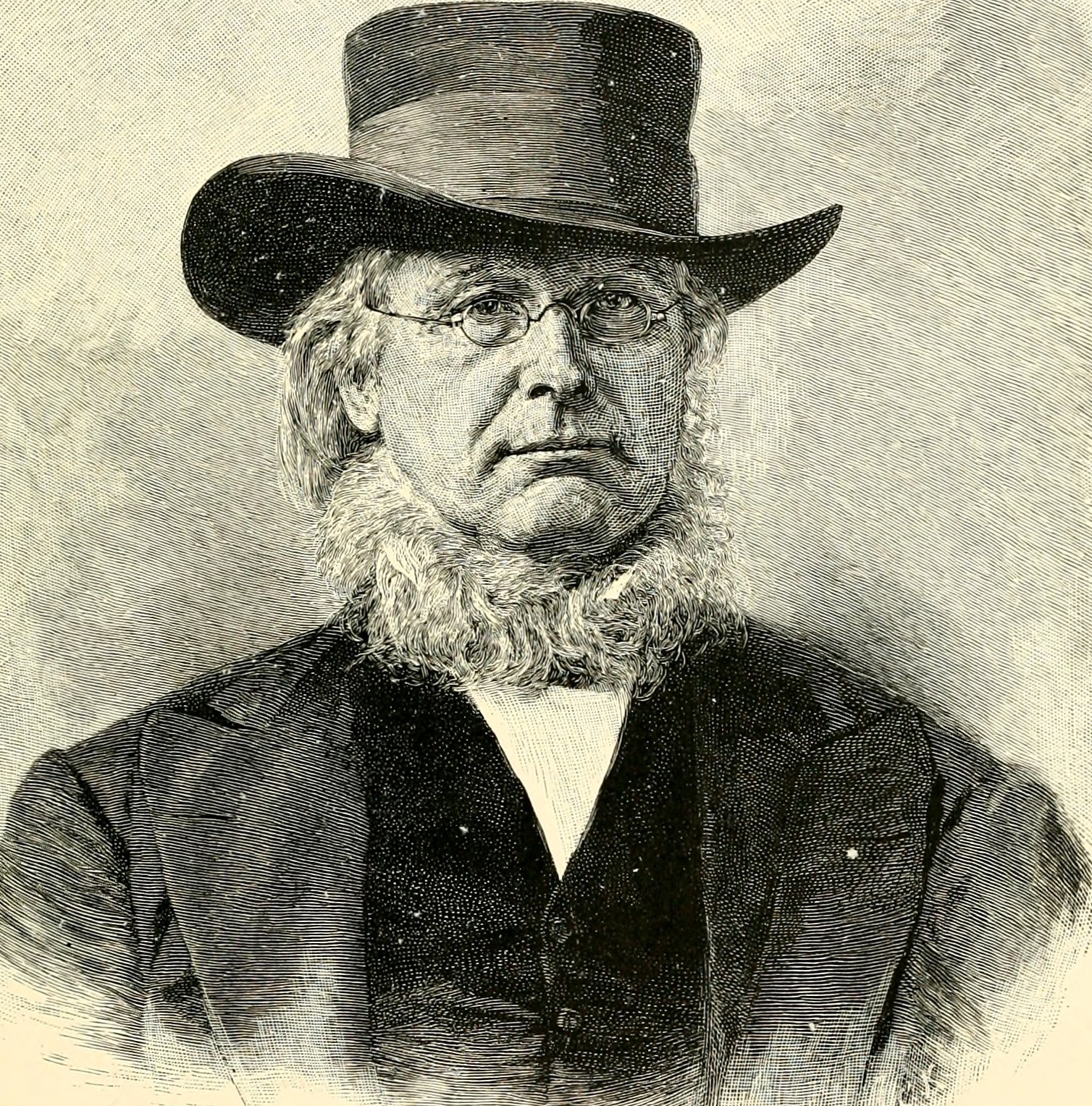
Horace Greeley may be remembered as the 1841 founder and editor of the New York Tribune. He may also be remembered as the Liberal Republican who, endorsed by the Democrats, lost his presidential bid against Ulysses Grant. Or as the man who gained the unfortunate distinction of being the only presidential candidate to die during the election process. Or maybe he will be remembered as the man who (allegedly) said, “Go West, young man!”
Whether Dr. Elizabeth Blackwell, the first woman to receive an MD, ever visited Vermont is uncertain; she most definitely never lived here. Ironically, Vermont’s role in Elizabeth’s career is something that didn’t happen: in 1847, she didn’t enroll at Castleton Medical School…
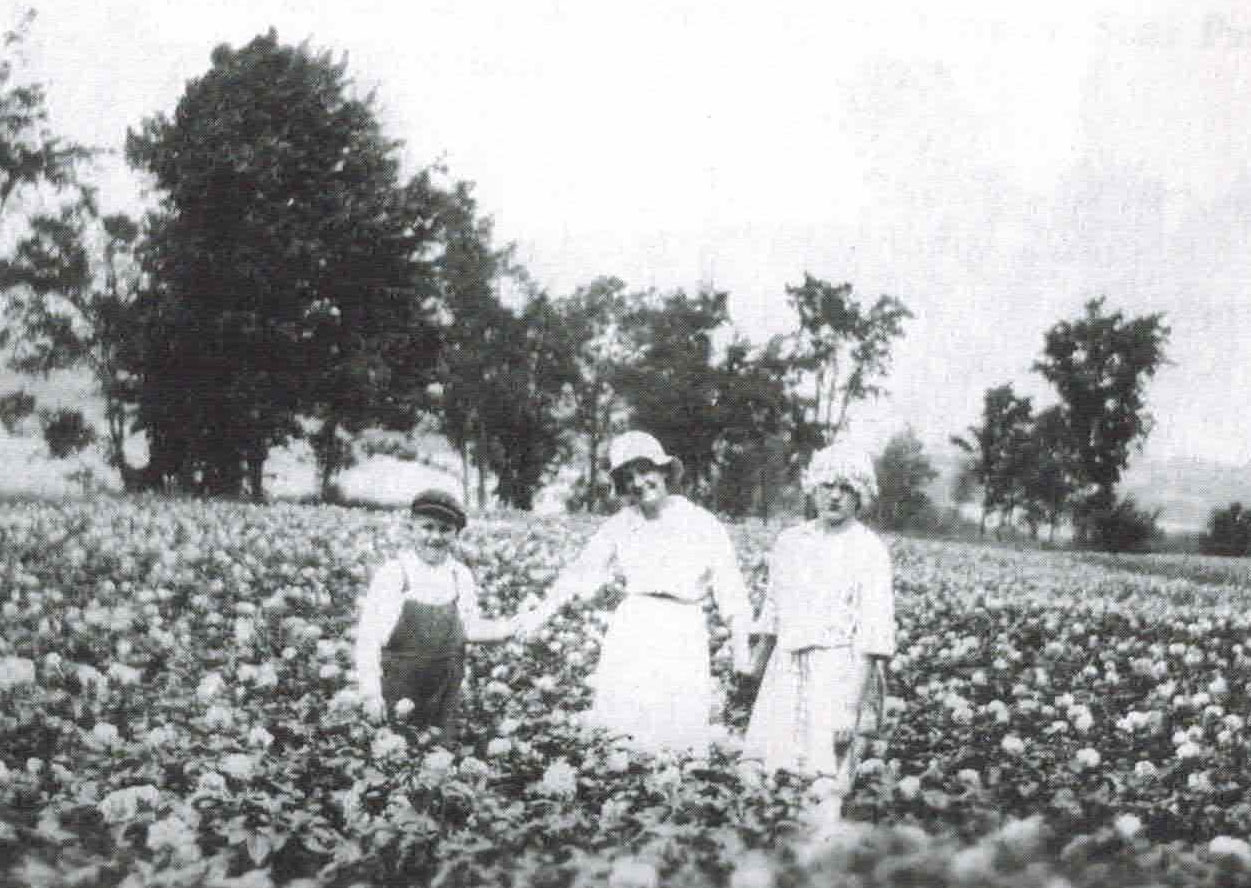
Castleton’s Poor Farm potato field, located where Crystal Beach is now on Lake Bomoseen), c. 1913. From Lake Bomoseen: The Story of Vermont’s Largest Little-Known Lake. Courtesy of Carol Thompson.
When Mrs. K. Lottie and her fourteen-year-old granddaughter were moved out of their cellar abode on Berlin Street, Montpelier, in February 1922, they didn’t go willingly. City officials, however, believed the two women would be better cared for on the town-managed poor farm on Elm Street.
As Mrs. Lottie and her granddaughter were moving into their new “home” forty miles away, William Seeley was setting himself free from his. The “straight as an arrow” 72-year-old was done with sleeping on a straw mattress in a building on Goodrich Road that used to house smallpox patients. Having “every inclination to work,” he went in search of a better life than the one he was living on Burlington’s poor farm. But soon Mr. Seeley found himself in jail – where “tramps and vagabonds” were often sent at the time – arrested for the crime of vagrancy. Suddenly, the poor farm may not have seemed so bad.
Originally published in the Times Argus/Rutland Herald Weekend Magazine, December 24, 2022 for the “Remember When” column with the title,When Holidays Were a Ball
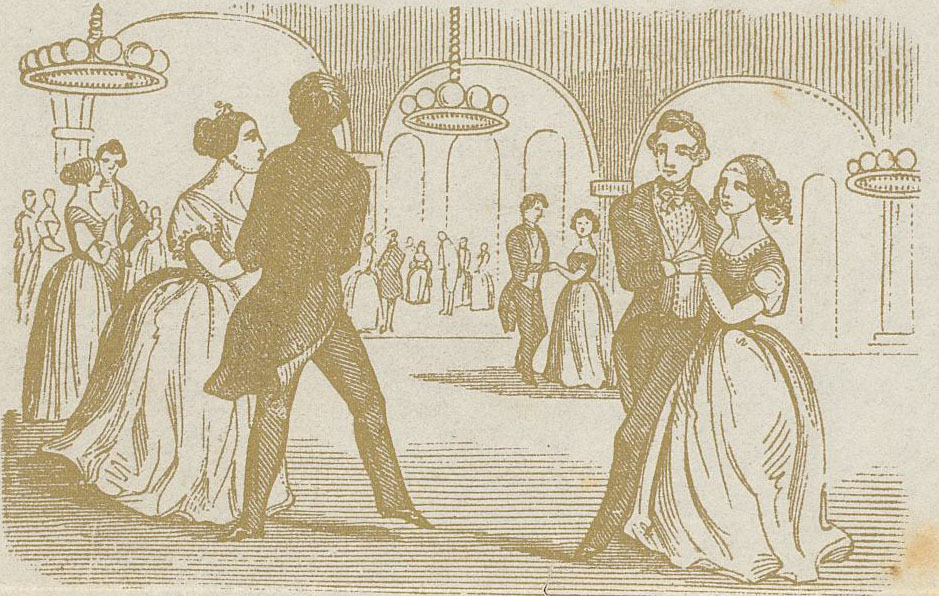
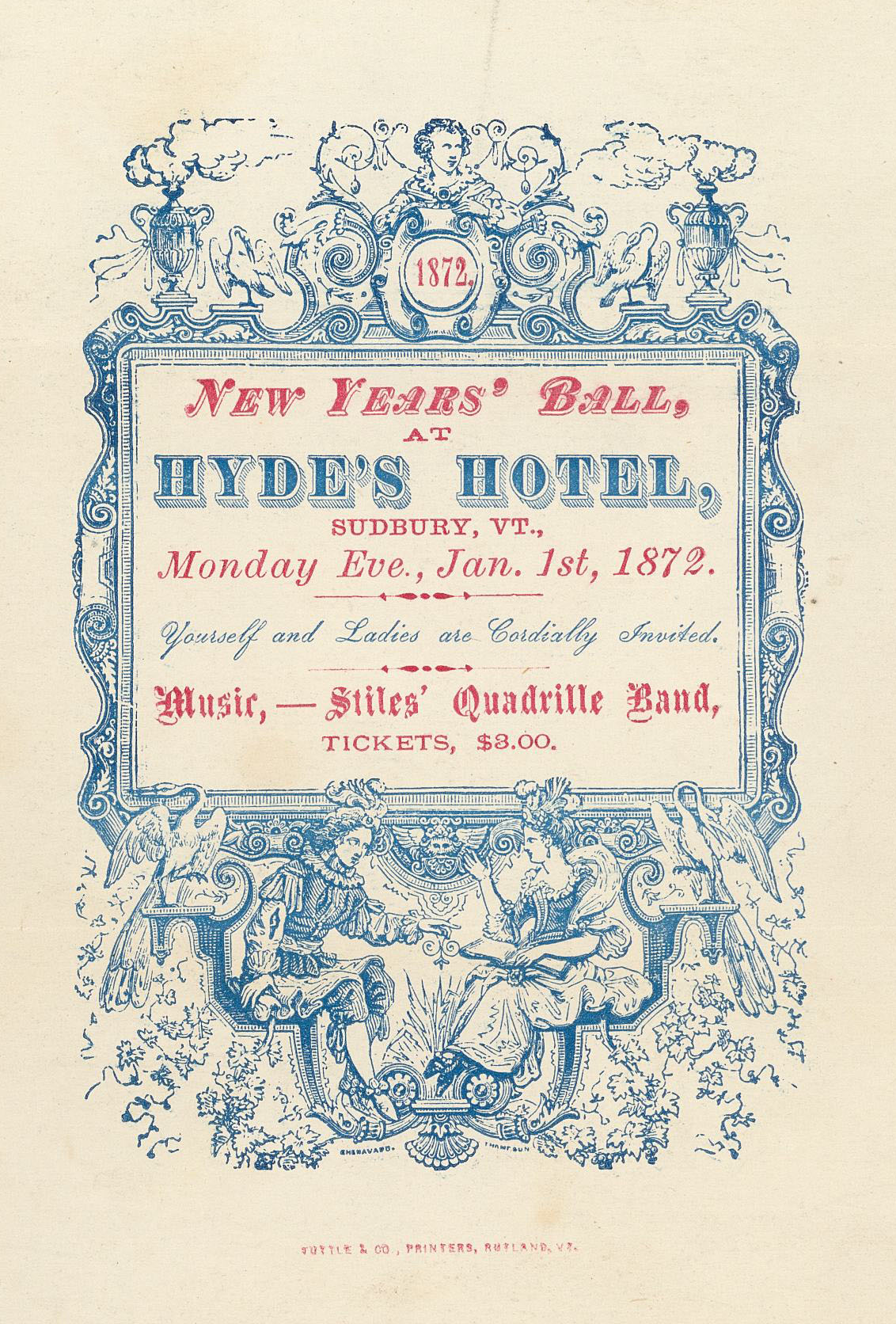
Once upon a time, even here in little ol’ rural Vermont, in the 19th century, any time seemed a good time for a ball. However, the holidays – from Thanksgiving through New Year – were a particularly popular time. And in a time of rapid industrial growth, the expanding middle-class was eager to enjoy the kind of fun previously afforded only to the Old Rich.
While private by-invitation-only balls and parties had been held earlier in the century – such as the ball held on Christmas Day, 1806 at Hyde’s Hall in Castleton – ticketed events open to the public weren’t generally known until mid-century. In fact, the first (known) advertised Christmas ball was in 1858. It was one of five “Anniversary Balls” listed in the Middle Register on December 15th, 1858 to be held at Hyde’s Hotel in Sudbury. (Some may recall the huge tumbling-down mansion on Route 30 just north of Hubbardton. This was the once-grand Hyde’s Hotel, or as it was renamed in the late 19th century, Hyde Manor.)
Snap-Apple Night by Daniel Maclise, 1833 (Wikicommons)
Originally published in the Times Argus/Rutland Herald Weekend Magazine, October 28, 2023 for the “Remember When” column with the title,Hallowed Apples
Today, apples aren’t generally associated with Halloween; fall, yes (it’s almost as if we are contractually obligated to go apple-picking this time of year), but apples are all together too un-scary for modern Halloween tastes. (Irony dictates that we must recall the scare of the 1960s and 1970s that first removed apples and other non-commercially-packaged goodies from trick-or-treat pails.)
However, apples and Halloween go way back. October 31 is the eve of Samhain, the Celtic New Year, a time of year when the veil between the worlds of the living and dead lifted. It has been also suggested by some historians (but not proven) that over the course of Rome’s occupation of Britain, two Roman celebrations — one, Day of the Dead, and the other in honor of the goddess of fruit, Pomona — commingled with the festivities of Samhain.
Burning bonfires and tying apples to evergreen branches to encourage the sun god to return, the ancients would also put food outside their doors to ease restless spirits. To avoid the spirits from recognizing them during the day, people wore masks, or in other cases, dressed up as them to collect food on their behalf. By the 16th century, especially in Scotland and Ireland, this ritual had evolved into children going “guising,” that is, dressing up in costumes and going door to door asking for food. Even into the 1960s, Irish children were asking their neighbors, “Any nuts or apples?” In some parts of Canada children used to say, “Halloween Apples” instead of “trick-or-treat.”
(Author’s aside: I had never trick-or-treated until I moved to the US in 1985. In the UK, November 5th — Bonfire Night or Guy Fawkes Day — was the time for bonfires and apple-bobbing. Ironically, dressing up or trick-or-treating on Halloween didn’t become A Thing until after the movie E.T. introduced Brits to the idea in the 1980s.)
It’s no great mystery why apples might be associated with this time of year: fall is when the apples are ripe. Apples are not only the last crop to be harvested but also the most versatile, and for our ancestors, especially here in the cold North, they were a life-source. Eaten straight off the tree, cooked into baked goods, dried for later use, preserved as apple butter, fermented into cider, or fed to the pigs, from fresh to rotting, apples were (are) the fruit that keeps on giving.
For this reason, an affinity with apples also made sense mystically to the ancients. As the last food-source available before the land became barren once again yet “living” through the winter in its various iterations, apples have always been associated with immortality. And as their spring blossoms herald renewed life, their womb-like nature — round with seeds at the center — also symbolized fertility and love. As Samhain was a time when our ancestors looked to the future, apples also became central to fortune-telling rituals and games for thousands of years. Here are a few favorites from the 18th century:
Snap Apple: Two sharpened sticks, tied into a cross-shape and with an apple and a burning candle stuck on opposite points, were hung from the ceiling. When the contraption was set in motion, unmarried men and women, hands behind their backs, took turns trying to catch an apple in their mouth. Winning determined who was to marry first.
Apple-bobbing (or donking): Young women would secretly mark their name on an apple which was then set afloat in a tub of water. Bachelors would then try to retrieve an apple with their mouth. The name on the procured apple predicted which of the girls he would marry.
Apple-peel throwing: While preparing apples for their various uses, girls would try to peel the skin in one continuous ribbon. The peeling was then thrown over the shoulder and the shape in which it landed supposedly formed the initial of her future husband.
While the Puritans didn’t bring such “heathen” ideas to America, Celtic/British traditions eventually made their way to New England with the Irish in the mid-19th century. Snap Apple doesn’t seem to have spread outside Vermont’s immigrant communities since there is no mention in the newspaper archives of the game outside of stories about the “Old World.” However, a safer version, where party-goers try to bite into a donut hanging from a string, did survive even into this century.
Fortune-telling was still part of Halloween party fun in the early 20th century, but, as the Bennington Banner proclaimed, “the revelers of 1912 scorn the old tricks carried out with apples, nuts, and the like and have invented new fun this year.” Instead, young ladies would peer through holes cut in a sheet to guess the male peeking through from the other side, or, as a 1927 article from Groton describes, gathered in a dark room, girls picked their “future husband, or second, as the case should be,” by correctly identifying that man’s silhouette on the other side of a sheet.
Apple-bobbing is the only age-old game that has remained in the modern consciousness. While maybe not a common element of Halloween parties today, it still shows up as a form of entertainment at some fall festivals. Thankfully, marriages are no longer dependent on the results.
These celebrations may be a world apart from the aesthetics and antics of a modern Halloween — a sight no ancient fortune-seeker could have ever predicted — but at our many annual apple and cider festivals, Vermonters still honor the ever-amazing apple that helped get generations of our ancestors through the winter.