Helen Hartness Flanders: Contributing to the literary history of our state

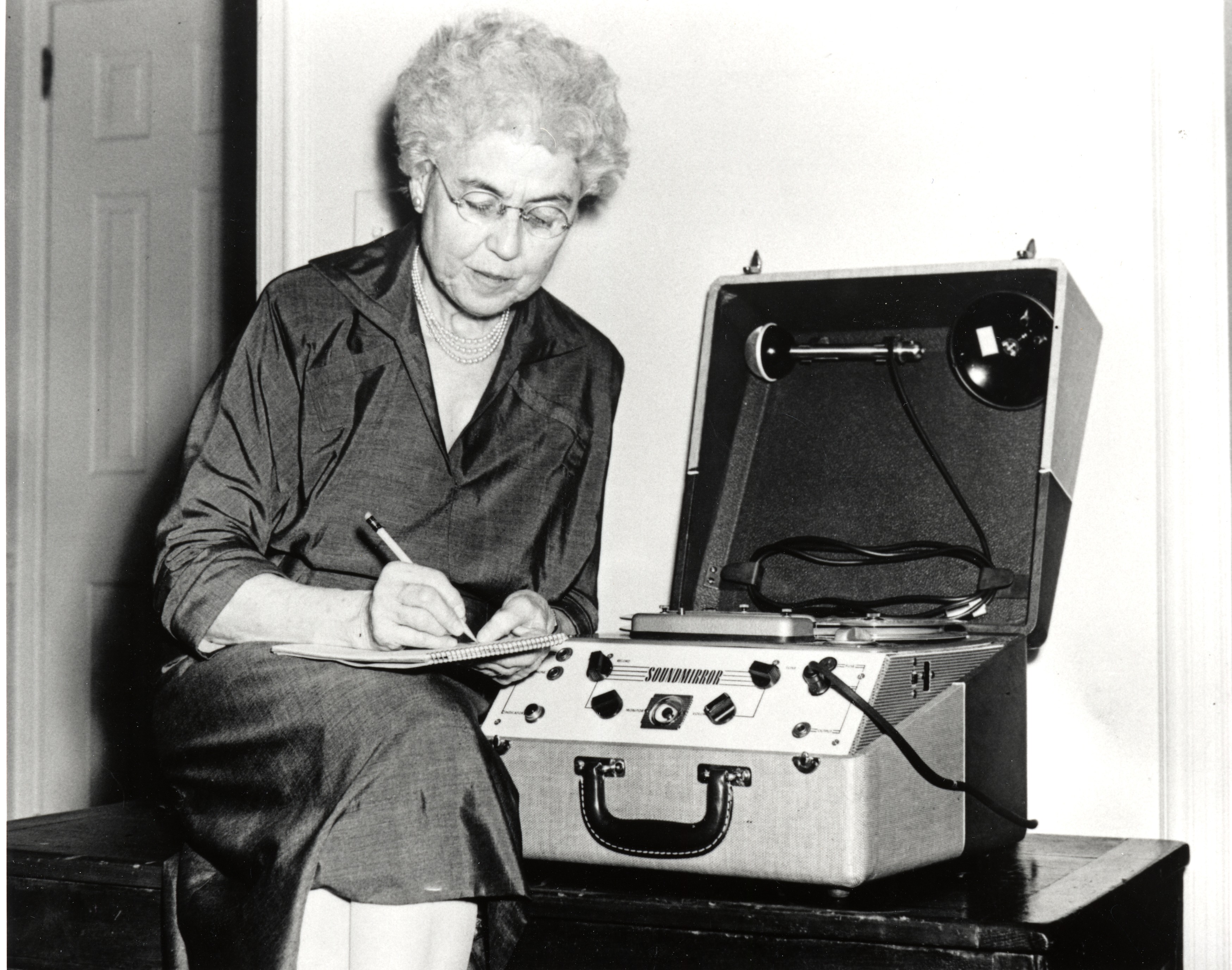
Helen Hartness Flanders with dictaphone (prob 1950s), 
 Middlebury College Special Collections, Middlebury, Vermont

Originally published in the Times Argus/Rutland Herald Weekend Magazine, March 25, 2023 for the “Remember When” column with the title, Capturing literary history

One day in the early 1930s, up the mountain road in Shrewsbury chugged an open-top car. Coming to a stop at Pierce’s Store, a middle-aged woman stepped out and warmly greeted Mrs. Pierce, the store’s proprietor. The visitor was Helen Hartness Flanders and she was in Shrewsbury to capture a sound of the past. 

Fifty years later, at age eighty-three, Marjorie Pierce remembered this day with a smile, the day Mrs. Flanders hauled a bulky dictaphone out of her car and asked her mother to sing into it.  

Helen Hartness was born in 1890 in Springfield, Vermont to Lena Pond and James Hartness, inventor and head of Jones & Lamson Machine Co. and governor of Vermont from 1921 to 1923. After graduating from Dana Hall in Wellesley, MA in 1909, Helen often traveled from Vermont to Boston to study music under the pianist and composer, Heinrich Gebhardt. When she was twenty-one, Helen married a business acquaintance of her father, Ralph Flanders, a mechanical engineer, and eventual US Senator. 

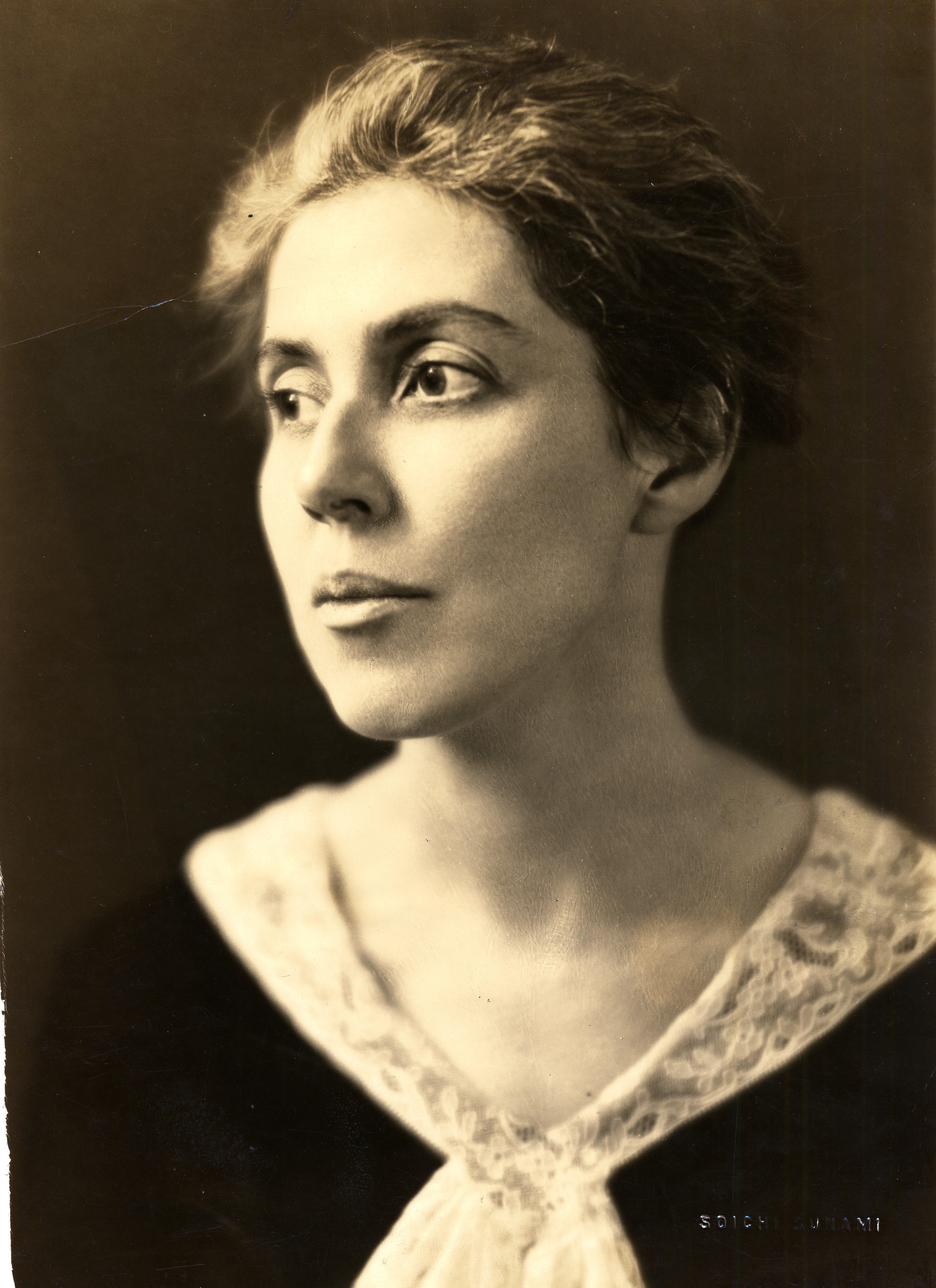
Helen Hartness Flanders in 1920s (Midd. College Special Collections)

Helen was not just a gifted musician but also a poet. Mingling with Springfield’s literary elite at her family’s home, Smiley Manse, where Robert Frost and Dorothy Canfield Fisher were among her guests, she soon caught the attention of Vermont’s higher ups.

Read more: Helen Hartness Flanders: Contributing to the literary history of our state

In early 1930, Gov. George Weeks asked Helen to join the committee on Vermont Traditions and Ideals, a branch of the Vermont Commission on Country Life (a program which grew out of Prof. Henry Perkin’s Eugenics Survey). Made Chairman of the Vermont Songs Survey, she became part of a team tasked with creating a four-volume collection of Vermont prose, poetry, biography, and folklore.

With the rise of radio, interest in traditional music had waned throughout the previous decade. As the last generation of ballad singers began to die out, there was concern that this aspect of Vermont’s history—what Helen called “hand-me-down singing”—would soon be lost. 

Helen spent most of the first summer researching and writing letters and articles to newspapers around the state asking for the public’s assistance in her important mission. “What I have come upon in our State shows me that Vermont, which we all know has a way all of her own in growing scenery and men, has an equally distinguished way of growing her music,” she wrote to the Burlington Free Press. “Please search your memories and write to me.” 

With letters with the names of those who still sang the old music starting to arrive in Helen’s mailbox, she and her partner, George Brown, a cellist and conductor of the Springfield summer orchestra could begin song collecting in earnest. Traveling with a thirty-pound wax cylinder dictaphone that ran off huge batteries carried in the back of the car, by October 1930, they had collected seventy-five songs just in southern Vermont. 

Helen had a particular knack of coaxing songs out of people, writes Deborah Clifford, author of Remarkable Vermont Women, most of whom were over sixty-years-old, and often reticent to sing for a stranger. But, as Helen wrote in the introduction to her 1931 book, Vermont Songs and Ballads, by agreeing to do so, they “contribut[ed] to the literary history of our state.”

Searching at first specifically for “Child Ballads”—considered the oldest narrative songs originating in England—they ultimately collected many songs that were “very human stories that were made into song too far back in the generations to have any known origin.”

However, as Helen told attendees of the 1930 annual PTA meeting in Brattleboro where she shared some of her finds, there was “a flavor as particular to Vermont as any Kentucky mountain song had to that state.” Often these were “written to commemorate calamities or deeds of heroism,” the Springfield Reporter explained. One such song, sung for the PTA members by Josiah Kennison of Townshend, was “The Snow Storm,” a ballad about what came to be known as the Stratton Mountain Tragedy. 

By the time the Commission’s funding ran out, Helen was fully hooked on song collecting, and partnering with Harvard musicologist, Phillips Barry, used her own money to continue the work she had fallen in love with. “The intangible, indescribable delights which went with the collecting of each song are not filed with them. These cannot exist in words,” she wrote in 1939. “Even that moment before driving out of the yard, with the dictaphone, address books, looseleaf notebooks, etc., on the seat of the car, cannot be distilled into the written word. Just beyond the windshield is the day-which one regards as untouched and undoubtedly undeserved (in the flurry of what is to be neglected at home)-so different each time, but always so electric with the unknown.” 

Vermont didn’t make her job easy, however. Due to deplorable conditions of the back roads, collecting had to be suspended during winter months. Some of the old “songsters” on her list died before she could get to them. Each year she waited impatiently for the end of mud season. “To the folksong collector… spring is far more than joy in full-running streams and bird-songs,” she once said.

In 1941, when the slew of recordings and papers began overwhelming her home, Helen donated the collection to Middlebury College. (A year later, Middlebury awarded her an honorary MA degree.) Marguerite Olney, a graduate of Eastman School of Music with whom Helen had recently begun collaborating, curated the collection and took over the majority of fieldwork throughout the 1940s and 1950s. The two books the women ultimately co-authored brought Helen’s stack of published works on folk music to eight (in addition to her poetry volumes, a children’s play, and bylines in newspapers throughout New England).

Despite living in Washington DC for stretches of time over the twelve years her husband held office, Helen continued to work on the collection. In fact, with Marguerite’s help, the mission expanded beyond Vermont’s borders. Gathering religious, children’s, and popular songs, dance tunes and folktales from all around New England and New York, by 1958, the collection had grown to almost 5,000 recordings—including some performed by ethnomusicologist Alan Lomax—broadsides, hymnals, manuscripts, and transcriptions, plus several thousand books on American folksong, folklore, and balladry.

As Helen entered her twilight years, she spent most of her time home at Smiley Manse cataloging the collection. In 1967, her name was the first to be inscribed on Vermont’s Roll of Distinction in the Arts.

Just days after turning eighty-two, Helen—nicknamed the “First Lady of Springfield”—died. The poetess and balladeer, as her obituary called her, was remembered as kindly, modest, humorous, and hard-working, and was lauded as a woman with “tact, good sense and ability.” Her “most extensive knowledge of Vermont lore [was] perhaps more than anyone else in the state.”

Today, folklorists and musicians from around the world continue to consult the Helen Hartness Flanders Ballad Collection. The voices of yesterday can still be heard, the stories a reminder of Vermont’s past, captured in song.

The Snow Storm

The cold winds swept the mountain’s height,
And pathless was the dreary wild,
And mid the cheerless hours of night
A mother wandered with her child:
As through the drifting snow she pressed,
The babe was sleeping on her breast.
And colder still the winds did blow,
And darker hours of night came on,
And deeper grew the drifting snow:
Her limbs were chilled, her strength was gone:
“Oh, God!” she cried, in accents wild,
“If I must perish, save my child!”
She stripped her mantle from her breast,
And bared her bosom to the storm,
And round the child she wrapped the vest,
And smiled to think her babe was warm.
With one cold kiss one tear she shed,
And sunk upon her snowy bed.
At dawn a traveler passed by,
And saw her ‘neath a snowy veil;
The frost of death was in her eye,
Her cheek was cold, and hard, and pale;
He moved the robe from off the child,
The babe looked up and sweetly smiled!

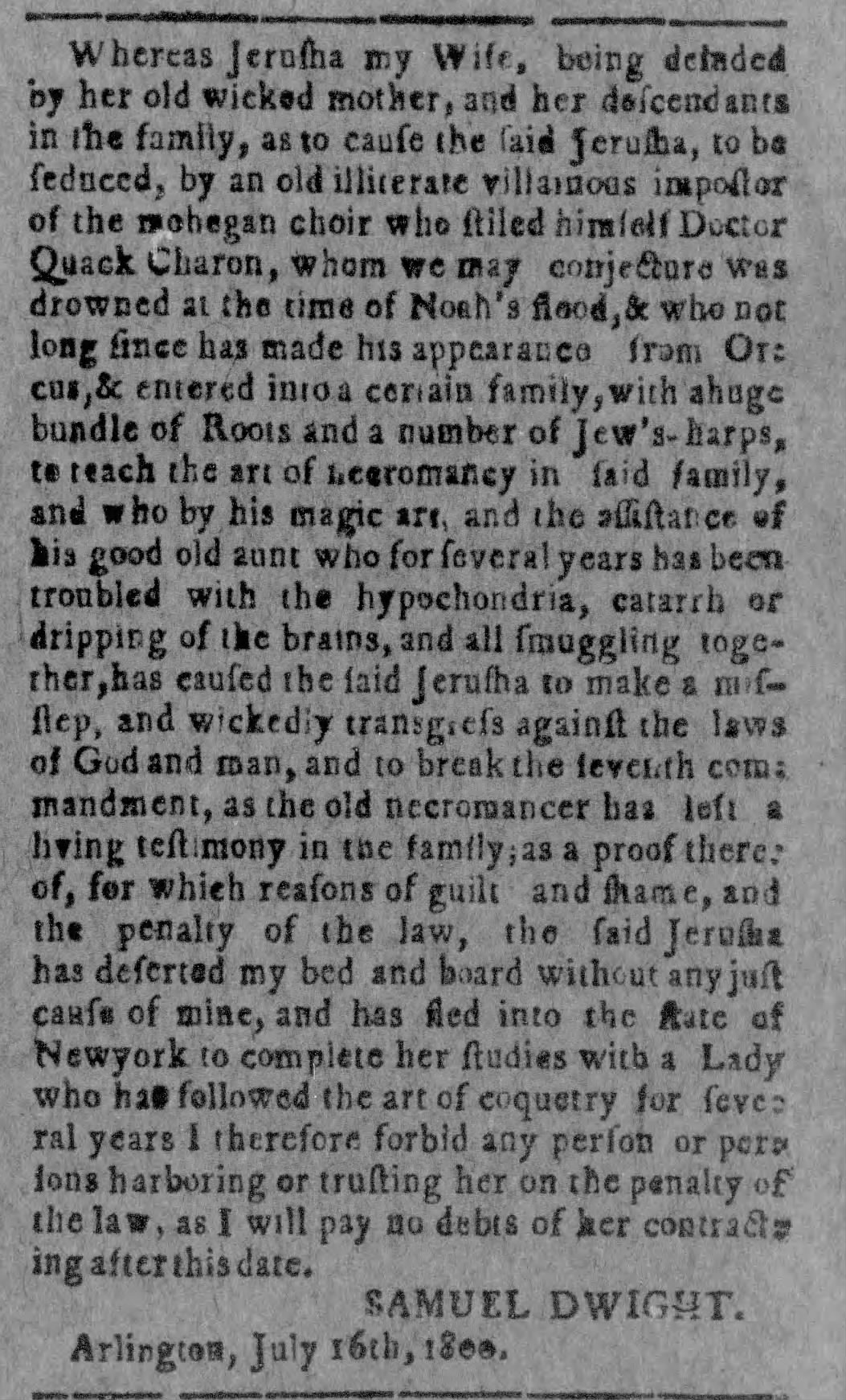
Whereas Jerusha my wife…

Transcription:

Whereas Jerusha my Wife, deluded by her old wicked mother, and her descendants in the family, as to cause the said Jerusha, to be seduced, by an old illiterate villanous imposter of the [mohegan?] choir who styled himself Doctor Quack Charon, whom we may conjecture was drowned at the time of Noah’s flood, & who not long since has made his appearance from Orcus, & and entered into a certain family, with a huge bundle of Roots and a number of Jew’s-harps, to reach the art of necromancy in said family, and who by his magic art, and the assistance of his good old aunt who for several years has been troubled with the hypochrondria, catarrh or dripping of the brains, and all smuggling together, has caused said Jerusha to make a misstep, and wickedly transgress against the laws of God and man, and to break the seventh commandment, as the old necromancer has left a living testimony in the family, as a proof thereof, for which reasons of guilt and shame, and the penality of the law, the said Jerusha has deserted my bed and board without any just cause of mine, and has fled into the state of Newyork to complete her studies with a Lady who has followed the art of coquetry for several years I therefore forbid any person or persons harboring or trusting her on the penalty of the law, as I will pay no debts of her contracting after this date.
SAMUEL DWIGHT
Arlington, July 16th, 1800

(as published in the Vermont Gazette, August 4, 1800)

The legacy of Castleton’s Calvin Coolidge Library

Originally published in the Times Argus/Rutland Herald Weekend Magazine, February 25, 2023 for the “Remember When” column with the title, The Right to Read and Savor.

This article was written in response to a plan to remove the majority of books from Vermont State College’s libraries. This terrible idea was — thankfully — eventually abandoned.

“A library is the nucleus of an educational facility… a college can only be as good as its library.” — Castleton State College Long Range Objectives Report, 1976 

Students studying at Castleton State College’s Calvin Coolidge library in 1958

Last week I drove over to Castleton to my alma mater. I walked through campus, stepping over the plaques embedded in the path, each engraved with a name of the school, from Rutland County Grammar School in 1787 to today’s Castleton University. Even thirty years after I graduated, this still feels like home. Pushing open the door into the Calvin Coolidge library, I was filled with the same mixed sense of calm, comfort, and excitement as I had as a student. Surrounded by the intangible presence of knowledge, I spent many hours here studying, researching, browsing—learning who I was and wanted to be. 

Michele, one of the incredibly helpful and knowledgeable Castleton librarians, showed me into the Vermont Room where the information I needed for this column is stored in file boxes, on shelves, and safely behind glass (including a green bound copy of my own History Honors thesis). There I sat for a few hours—and wanted to stay for many more—carefully leafing through the ephemera, much of which is priceless (and un-digitizable) pieces of Castleton’s—and Vermont’s—history: two hundred-year-old log books, one hundred-year-old course catalogs, faded photographs of Mercel-permed students, and mimeographed letters from the 1960s. 

Continue reading

Lucy Terry Prince: Early Vermonter and First African-American Poet 

Originally published in the Times Argus/Rutland Herald Weekend Magazine, February 4, 2023 for the “Remember When” column with the title, Lucy Terry Prince

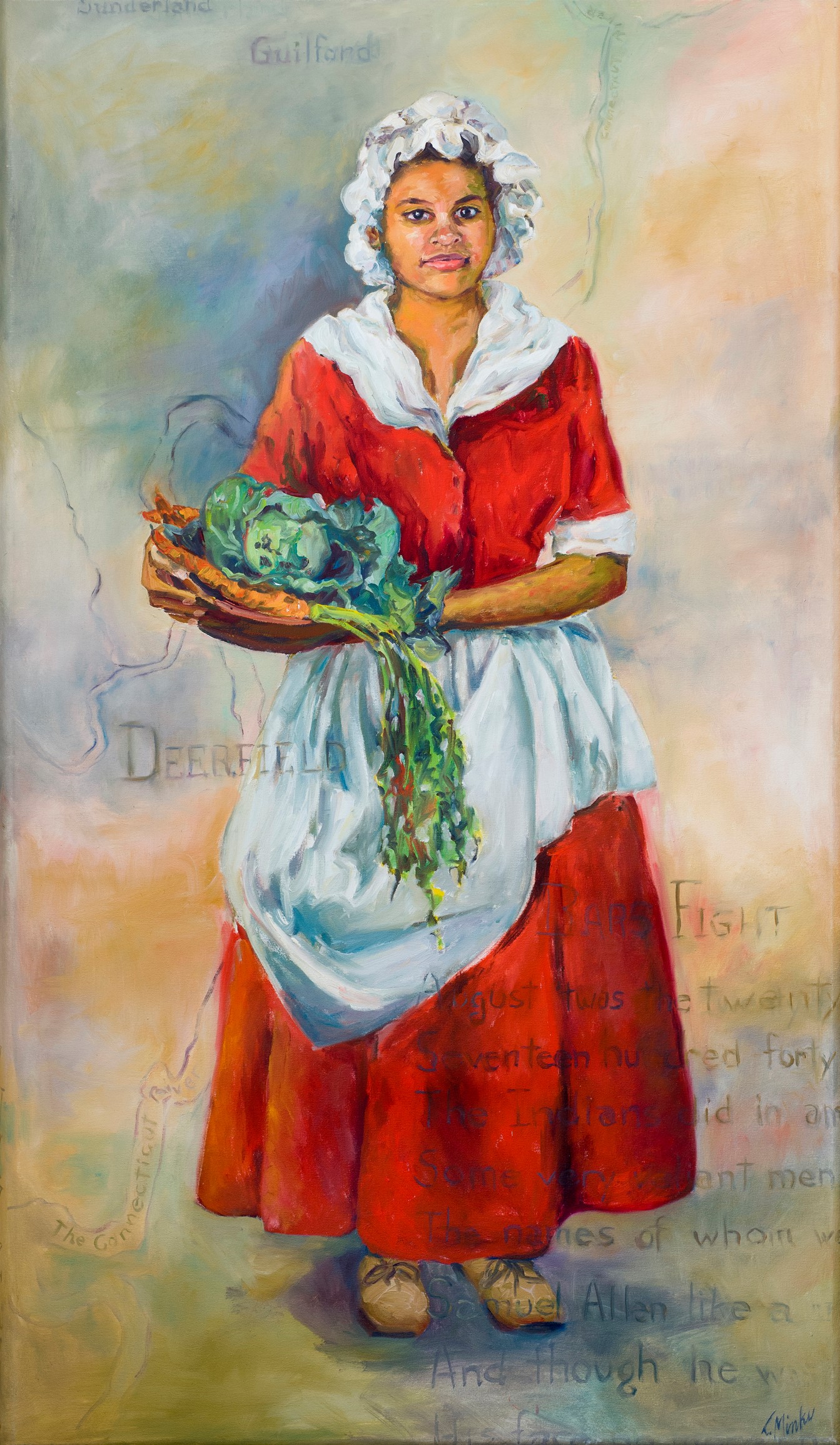
Lucy Terry Prince by artist Louise Minks

On August 14th, 1821, an unusual obituary ran in the Bennington’s Vermont Gazette. It was particularly detailed and for a woman, a black woman. Furthermore, this “remarkable” and “much respected woman” in whom “there was an assemblage of qualities rarely to be found among her sex,” was one of the first settlers in what would become the state of Vermont. 

If that’s not enough, she is considered this country’s first known African American poet. 

The story of Lucy Terry Prince is as fascinating as it is complex. The many twists and turns of her 90-plus years cannot possibly be captured here – what follows is the barest outline of a life that bore witness to the very beginnings of what would become the United States. (For a meticulously researched, in-depth study of her and her family, see Gretchen Holbrook Gerzina’s Pulitzer Prize nominated Mr. and Mrs. Prince: How an Extraordinary Eighteenth-Century Family Moved Out of Slavery and Into Legend.)

In approximately 1730, a little girl was born in Africa, who, when barely out of toddlerhood, was kidnapped and shipped off to the American colonies. Most likely landing in Boston, she was sold to Samuel Terry and given the name Lucy. From there she was sold to Ebenezer and Abigail Wells of Deerfield, MA, becoming an integral – but far from equal – member of the family.

Continue reading

Stone Storytellers: The Stonewalls of Vermont

Originally published in the Winter 2022 Rutland Magazine with the title, “Tumbling through Time.” (All photos taken by Joanna Tebbs Young)

When I was teenager, my father was obsessed with old stone walls. Old Vermont stone walls, to be precise. 

There’s an old stone wall,” he’d say as he attempted to steer our 1979 maroon Pontiac ship-of-a-station wagon around the dried mud waves of some back road. We hadn’t long moved from England and many a weekend was spent exploring our new home state, which for my father meant turning down every dirt road we happened upon. 

“Look at that old stone wall,” he’d say to no one in particular as my sister and I bumped and swayed on the beige spider-veined vinyl of the back seat. 

“Oh, that’s a really old one.” 

To humor him, I sometimes generously offered a “oh, yeeeaaah.” But seriously? A stone wall? Whoop-de-do.

~~

Thirty years later, my teenage son slouches in the back seat, straining against the tight seat belt as he tries to conform his length to our compact car. He is all hoodie, earbud cords, and legs. He begrudgingly joined this road trip only when bribed with promises of McDonald’s iced coffee. 

We’re driving on a not-quite-dirt road near Shrewsbury, near Windsor, Springfield, Reading, hillside properties either side. The leaves are gone, the views are spectacular. Even in the brown-gray of November, Vermont awes. There are fields and there are woods, there are lawns and there are barns. 

And there are old stone walls. 

“There’s one!” I say. “Wow, that one really survived well!”

“And another one! 

My husband obligingly acknowledges the tumble of rocks just visible in the tangled undergrowth. Silence from the back seat. Except for the rattle of ice cubes and scree-scree of a straw in a plastic cup. 

“So, I know you don’t really care,” I say, glancing back at my son, “but I’m going to tell you about these walls anyway. We are surrounded by history and knowing it is important.” 

 “Aaaand, you never know…” I smile with mother-is-all-knowing-ness. “Maybe one day you’ll tell your kids about them.”

He peeks out from under his hoodie. “Yeeeaaah.”

~~

Vermont’s stone walls tell a tale of time. Not merely evidence of the immigrant and native-born farmers who settled here in the late eighteenth and early nineteenth centuries, these walls summon a far older story. The stones puzzle-pieced into these walls tell of a land that wasn’t always green, rounded, and rivered. Smoothed into craggy slabs and spheres over eons, these rocks are a reminder that long, long ago this land was created as retreating glaciers grazed granite mountains along their way. These stones, and the silt beneath them, are the literal bedrock of Vermont’s history and of the people who have chosen to call it home. 

Continue reading

Doing the Turkey… Trot?

Originally published in the Times Argus/Rutland Herald Weekend Magazine, November 26, 2022 for the “Remember When” column with the title, Doing the Trot: Three Centuries of a Turkey Tradition 

In February 1912, seemingly apropo nothing, a contributor to the St Albans Messenger quipped, “Vermont does not expect to see much of the turkey trot until just before Thanksgiving.” 

If written in today’s paper, most readers would assume this statement referred to the popular Thanksgiving Day foot-race where turkey-costumed runners proactively burn the calories they will consume later that day. Although by 1912 the event that is now known as the Turkey Trot had been around for sixteen years (the first turkey-day race was held in Buffalo, New York in 1896) the race had not yet claimed the monika it holds today. 

So, what was the St. Albans Messenger referring to? We can safely assume that contemporary readers would have understood it perfectly well. It was a pun. Because in 1912 the term “turkey trot” was going viral (so to speak). 

Let’s start with the “trot” of actual turkeys.

Continue reading

Haunts of History: How Halloween – and mischief – came to Vermont

Originally published in the Times Argus/Rutland Herald Weekend Magazine, October 29, 2022 for the “Remember When” column with the title, Up to No Good

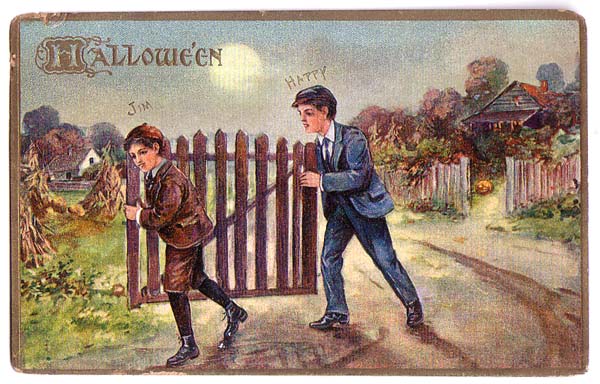
Cabbage Night was also known as Gate Night

“There is in every village and hamlet in America, a vulgar class of recreant mortals, who endeavor yearly to signalize the anniversary of ‘Halloween,’ by acts and deeds, more characteristic of devils than of boys or men.”

This moral outcry, published in the November 2, 1872 edition of the Middlebury Register, was in response to a “disgraceful scene” that had occurred that Halloween night. On Seminary Street in Middlebury, “the witches” had taken “gates off their hinges, and exchanged them for a neighbor’s gate… other gates were borne away to secret places.” Among “other annoyances too numerous to mention,” “door bells were rung.” Two cast iron lions were also taken from their perches atop a stone entryway and thrown in the mud. 

Why were the boys up to such mischief, and why on October 31st specifically? To answer that question we have to take a whirl-wind journey through 3,000 years, give or take a few, beginning with the ancient Celts. 

Continue reading

Apples, apples everywhere: When homegrown became Vermont’s business

Originally published in the Times Argus/Rutland Herald Weekend Magazine, October 1, 2021 for the “Remember When” column with the title, Apple of Vermont’s Eye

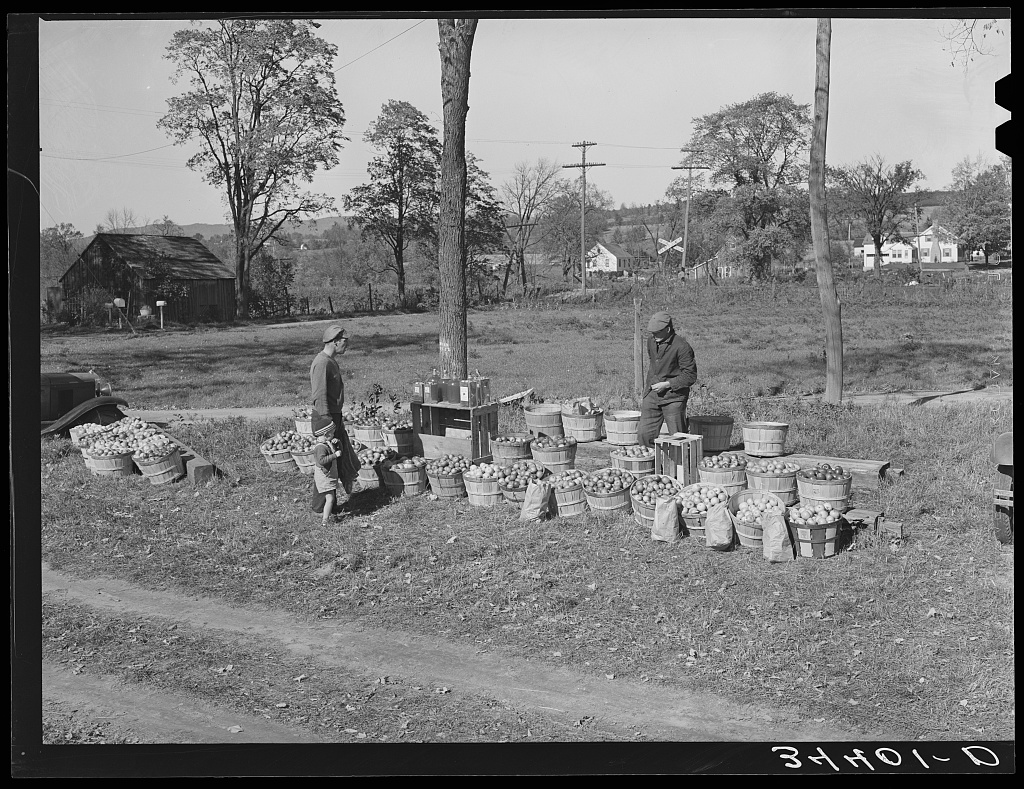
This roadside fruit stand was pictured near Bennington in 1939 (Library of Congress)

In September 1922, Bess M. Rowe penned an article for The Farmer’s Wife after she visited the Dimock Orchard Farm in East Corinth. In “Bringing Back the Old Trees,” Miss Rowe wrote of the charming conversations she had with the self-named “farmerettes” who, since taking charge while “the men” were away at war, continued to be instrumental to the farm’s successful operation. After Mr. and Mrs. Julian Dimock — a magazine writer and former professor, respectively, and farming novices both — moved to Vermont and started the farm 10 years earlier, they were proving themselves adept orchardists.

Their success could be put down to natural talent or, as Miss Rowe noted, their receptiveness to “modern ideas and methods,” and having “nothing to unlearn.” But the couple’s move into apple-growing also came at an opportune time in Vermont’s fledgling apple industry.

Continue reading

Early Female Education: Because Women were Cheaper

Originally published in the Times Argus/Rutland Herald Weekend Magazine, June 18, 2022 for the “Remember When” column with the title, “Female education: From the home to the school house

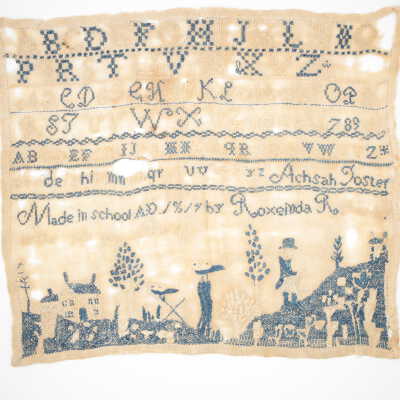
Sampler made in Orange, Vermont, with text: “Made in school A.D. 1814 by Roxcinda Richardson”
(Vermont Historical Society)

1800–20

Early Vermont women were far from uneducated. In the 1770s, literacy among females is estimated to have been at 60%, and by 1820, over 80%. But most girls educated prior to 1800 could only expect to learn enough basic skills to become a proficient housekeeper.

When Miss Ida Strong opened a girls-only school in Middlebury in 1800, it was the first of its kind in Vermont. The idea of designing schools and curricula specifically for girls was progressive and marked the beginning of a nascent trend in Vermont’s female education.

Continue reading

Educating women to be interesting wives

Originally published in the Times Argus/Rutland Herald Weekend Magazine, May 18, 2022 for the “Remember When” column with the title, “Female education, for happiness and cordiality

Sampler made in Orange, Vermont, with text: “Made in school A.D. 1814 by Roxcinda Richardson” in the 9th year of her age.
(Vermont Historical Society)

“Whatever the fine ladies think of the matter, it is certain that the only rational ambition they can have must be to make obedient daughters, loving wives, prudent mothers and mistresses of families, faithful friends, and good Christians.” 

From the “Of the peculiar Management of Daughters” in the August 14, 1802 edition of Randolph’s Weekly Wanderer

At a time when schooling was usually limited to subjects and skills deemed absolutely necessary to their future roles as wives and mothers, the above statement makes sense. But it was actually in an 1802 article written in support of furthering the formal education of young girls. 

Two years earlier, Miss Ida Strong – considered to be the “pioneer of female education in this state “ by Vermont’s more famous first lady of education, Emma Willard – had begun instructing the “various branches of Female Education” at the Middlebury Female Seminary. And in her belief that girls should receive a more well-rounded and thorough education than had their mothers and grandmothers, she was not alone. 

Continue reading