The legacy of Castleton’s Calvin Coolidge Library

Originally published in the Times Argus/Rutland Herald Weekend Magazine, February 25, 2023 for the “Remember When” column with the title, The Right to Read and Savor.

This article was written in response to a plan to remove the majority of books from Vermont State College’s libraries. This terrible idea was — thankfully — eventually abandoned.

“A library is the nucleus of an educational facility… a college can only be as good as its library.” — Castleton State College Long Range Objectives Report, 1976 

Students studying at Castleton State College’s Calvin Coolidge library in 1958

Last week I drove over to Castleton to my alma mater. I walked through campus, stepping over the plaques embedded in the path, each engraved with a name of the school, from Rutland County Grammar School in 1787 to today’s Castleton University. Even thirty years after I graduated, this still feels like home. Pushing open the door into the Calvin Coolidge library, I was filled with the same mixed sense of calm, comfort, and excitement as I had as a student. Surrounded by the intangible presence of knowledge, I spent many hours here studying, researching, browsing—learning who I was and wanted to be. 

Michele, one of the incredibly helpful and knowledgeable Castleton librarians, showed me into the Vermont Room where the information I needed for this column is stored in file boxes, on shelves, and safely behind glass (including a green bound copy of my own History Honors thesis). There I sat for a few hours—and wanted to stay for many more—carefully leafing through the ephemera, much of which is priceless (and un-digitizable) pieces of Castleton’s—and Vermont’s—history: two hundred-year-old log books, one hundred-year-old course catalogs, faded photographs of Mercel-permed students, and mimeographed letters from the 1960s. 

Continue reading
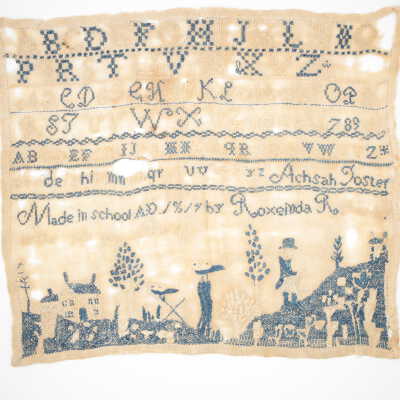
Early Female Education: Because Women were Cheaper

Originally published in the Times Argus/Rutland Herald Weekend Magazine, June 18, 2022 for the “Remember When” column with the title, “Female education: From the home to the school house

Sampler made in Orange, Vermont, with text: “Made in school A.D. 1814 by Roxcinda Richardson”
(Vermont Historical Society)

1800–20

Early Vermont women were far from uneducated. In the 1770s, literacy among females is estimated to have been at 60%, and by 1820, over 80%. But most girls educated prior to 1800 could only expect to learn enough basic skills to become a proficient housekeeper.

When Miss Ida Strong opened a girls-only school in Middlebury in 1800, it was the first of its kind in Vermont. The idea of designing schools and curricula specifically for girls was progressive and marked the beginning of a nascent trend in Vermont’s female education.

Continue reading

Educating women to be interesting wives

Originally published in the Times Argus/Rutland Herald Weekend Magazine, May 18, 2022 for the “Remember When” column with the title, “Female education, for happiness and cordiality

Sampler made in Orange, Vermont, with text: “Made in school A.D. 1814 by Roxcinda Richardson” in the 9th year of her age.
(Vermont Historical Society)

“Whatever the fine ladies think of the matter, it is certain that the only rational ambition they can have must be to make obedient daughters, loving wives, prudent mothers and mistresses of families, faithful friends, and good Christians.” 

From the “Of the peculiar Management of Daughters” in the August 14, 1802 edition of Randolph’s Weekly Wanderer

At a time when schooling was usually limited to subjects and skills deemed absolutely necessary to their future roles as wives and mothers, the above statement makes sense. But it was actually in an 1802 article written in support of furthering the formal education of young girls. 

Two years earlier, Miss Ida Strong – considered to be the “pioneer of female education in this state “ by Vermont’s more famous first lady of education, Emma Willard – had begun instructing the “various branches of Female Education” at the Middlebury Female Seminary. And in her belief that girls should receive a more well-rounded and thorough education than had their mothers and grandmothers, she was not alone. 

Continue reading