Originally published in the Times Argus/Rutland Herald Weekend Magazine, October 1, 2021 for the “Remember When” column with the title, Apple of Vermont’s Eye
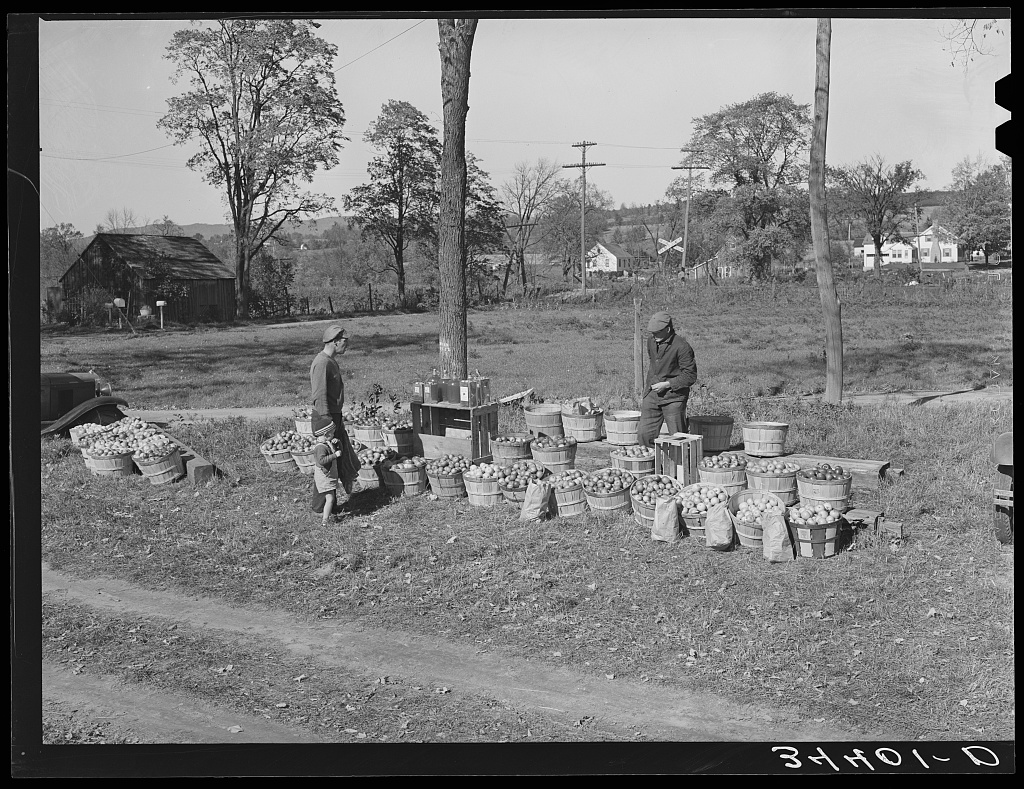
This roadside fruit stand was pictured near Bennington in 1939 (Library of Congress)
In September 1922, Bess M. Rowe penned an article for The Farmer’s Wife after she visited the Dimock Orchard Farm in East Corinth. In “Bringing Back the Old Trees,” Miss Rowe wrote of the charming conversations she had with the self-named “farmerettes” who, since taking charge while “the men” were away at war, continued to be instrumental to the farm’s successful operation. After Mr. and Mrs. Julian Dimock — a magazine writer and former professor, respectively, and farming novices both — moved to Vermont and started the farm 10 years earlier, they were proving themselves adept orchardists.
Their success could be put down to natural talent or, as Miss Rowe noted, their receptiveness to “modern ideas and methods,” and having “nothing to unlearn.” But the couple’s move into apple-growing also came at an opportune time in Vermont’s fledgling apple industry.
Prior to the 20th century, apples were generally grown in small backyard orchards, producing just enough of a crop to cover a family’s own needs. The best apples were eaten fresh from the tree or baked into various goodies and, to carry them through the winter, batches were dried or canned. Lower-quality apples were pressed into cider and mulched into animal feed.
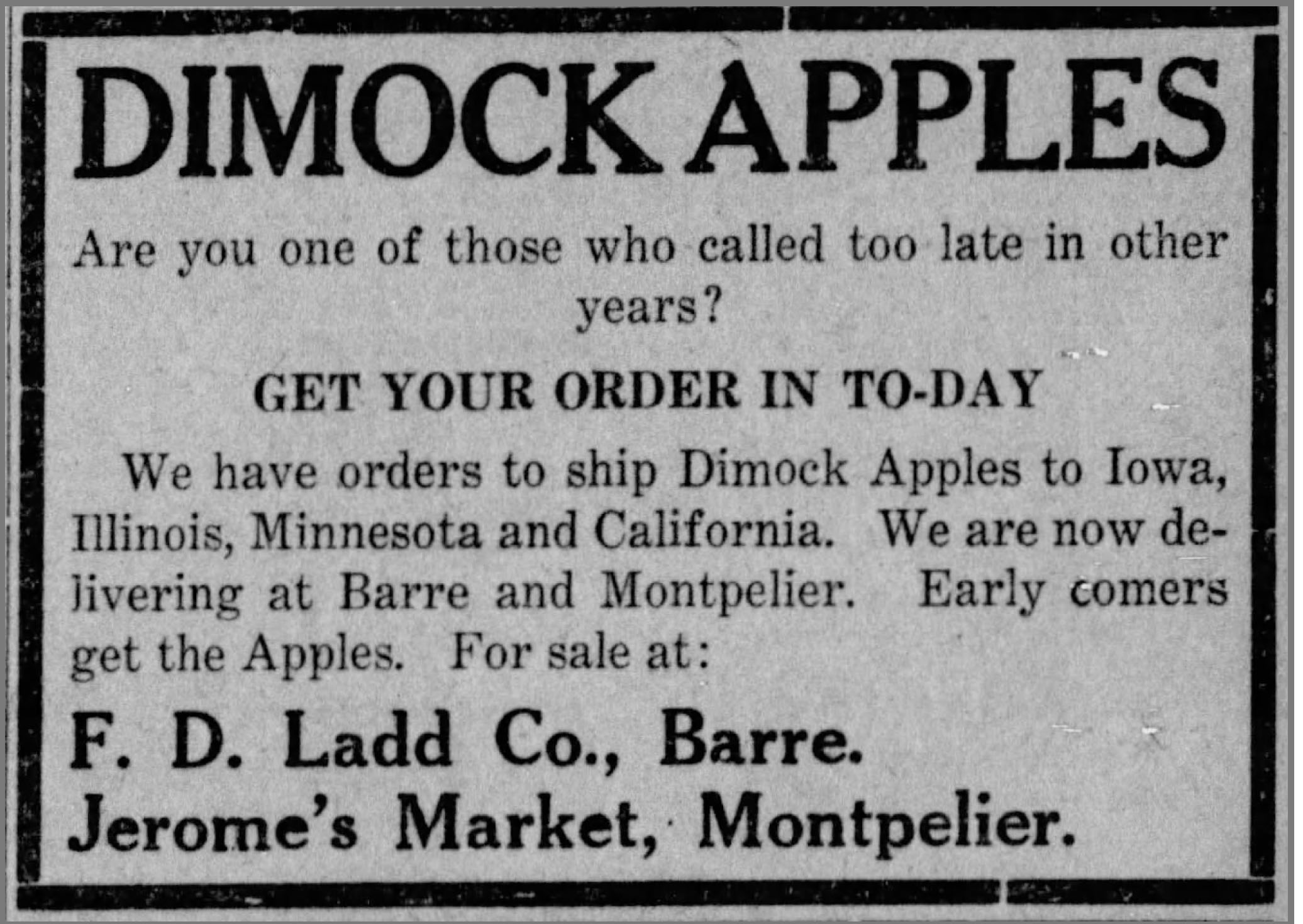
However, the early-1900s saw technological improvements which for farmers translated into better growing and storage methods for their crop plus an increased ability to transport it. Farmers — such as the Dimocks, who, in 1922, were tending 3,000 trees — steadily increased the size and variety of their orchards. According to “The View from Vermont” by Blake Harrison, between 1910 and 1925, more than 285,000 new apple trees were planted throughout the state.
The growing number of “Apple-Pickers Wanted” newspaper ads reflects this rapid growth as more farmers looked to local men and women to help during the labor-intensive harvest months. As extra incentive, some farmers even offered room and board. At the Dimock Orchard, for example, at least three of the women, all college-educated and pursuing farming careers themselves, traveled from their home states to live on the farm during its busiest months.
One of these women, Mildred Smith, was in charge of marketing the farm. Yes, marketing. While this job title might sound more 2022 than 1922, it was right in line with the new era of farming in Vermont. These larger orchards could afford to produce more apples because there was a market for them. As Mr. Dimock assured Miss Rowe, “there would be a good market so long as their product maintains its present standard of quality in itself and the package.”
There was also a newly improved way to transport that product. Manufactured ice had by this time become more common and in 1920, with its new fleet of refrigerated rail cars, the company Fruit Growers Express began serving the Eastern wholesale produce market. Just two years later, Dimock was shipping apples across the country, including to Iowa, Illinois, Minnesota and California. Long Island, however, was their largest customer.
However, many apples were also staying right at home. While they were often available through local grocers, many Vermonters sought out the orchards themselves. And at a time of increased car ownership, this became far simpler. For example, Dimock, according to Miss Rowe, was often “overrun with Sunday auto parties.” Indeed, the Sunday prior to her visit that September of 1922, “54 people ate Sunday dinner on the place.”
Beginning in the 1930s (as covered in October 2021’s edition of this column, “Falling for Vermont”), Vermont was heavily advertised as a Fall Destination to potential tourists. Like maple syrup, apples were already well-established as a Vermont product. Capitalizing on this, marketers successfully “sold” Vermont as the image and taste of autumn.

The so-called traditional ways of farming were heavily romanticized (especially by the magazine Vermont Life in the 1940s), and apple pies, cider, pick-your-own and harvest festivals became emblematic of the state. Farm-stands also began to pop up along the back roads, which farmers, with advice from the Vermont Agricultural Experiment Station, began to make ever more attractive to passing motorists, especially leaf-peepin’ tourists. Some farms, such as East Clarendon’s Haven Hill, enticed visitors with promises of specific varieties, such as the Macintosh, an apple native to Canada that gained popularity after becoming available commercially in New England in the late-1800s.
For those who couldn’t travel, the 1930s also saw some farms beginning to mail-order ornate gift packages of apples and other Vermont products.
Yes, Vermont is a gift, a gift of food and foliage and fun — this is what the early-20th century tourism marketers wanted the world to know. According to Miss Rowe, orchardists like the Dimocks and their farmerettes were showing a “genuine pioneer spirit” and proving what the state “can do in the way of food production” to “feed the people of the world.” A bit hyperbolic but, hey, that’s marketing.
However, this little expedition down the apple grove of history can’t go without a reminder that the origins of Vermont’s tourism industry isn’t quite as sweet as our apple doughnuts, pies and cider. The Vermont brand that was established a century ago and still remains to this day, was sold to a very specific population of the “right people.” It is a bitter legacy, the fruit of which we are still tasting. (More on this can be found at rutlandwhen.wordpress.com/tag/eugenics/)
 Vermont When...
Lovely piece to read again. Especially love the Haven Hill advertisement. Do you know where that was in E Clarendon?
Thanks, Thomas. I’ll see if I can find out where it was.
Thank you
Here ya go! https://www.clarendonvthistory.org/HSWF_DisplayItem?ID=672&XS=A